

Markup = (Selling Price - Cost) / Cost x 100. That's the formula. A product that costs $20 and sells for $50 has a markup of ($50 - $20) / $20 x 100 = 150%.
Sounds simple. But markup and margin are the two most confused numbers in ecommerce — and mixing them up means you're either leaving money on the table or pricing yourself out of the market. This guide covers both formulas, shows you exactly how to convert between them, and gives you the industry benchmarks to price with confidence.
The Markup Formula
Markup tells you how much you've added to your cost to arrive at the selling price. It's always expressed as a percentage of cost.
| Formula | Expression | What It Answers |
|---|---|---|
| Markup % | (Selling Price - Cost) / Cost x 100 | How much did I add on top of my cost? |
| Selling Price from Markup | Cost x (1 + Markup%) | What should I charge for a given markup? |
| Cost from Markup | Selling Price / (1 + Markup%) | What's my max cost for a target markup? |
Example: You source a product for $12. You want a 200% markup. Selling Price = $12 x (1 + 2.00) = $12 x 3.00 = $36.
Reverse it: you see a competitor selling at $36 and you know COGS is about $12. Their markup is ($36 - $12) / $12 x 100 = 200%.
The Margin Formula (For Comparison)
Margin tells you what percentage of the selling price is profit. It's always expressed as a percentage of selling price (revenue).
Margin % = (Selling Price - Cost) / Selling Price x 100
Using the same example — a $12 cost sold at $36: Margin = ($36 - $12) / $36 x 100 = 66.7%.
Same product. Same $24 profit. But markup says 200% and margin says 66.7%. That's because they use different denominators — cost vs selling price. This difference is the source of every pricing mistake founders make. For a deeper dive on what constitutes a healthy margin, see our guide to good ecommerce profit margins.
Markup vs Margin: The #1 Confusion in Ecommerce
Here's why this matters. If your supplier says "we recommend a 50% markup" and you think that means 50% margin, you'll price your product wrong.
| Scenario | Cost | Selling Price | Profit | Markup | Margin |
|---|---|---|---|---|---|
| 50% markup | $20 | $30 | $10 | 50% | 33.3% |
| 50% margin | $20 | $40 | $20 | 100% | 50% |
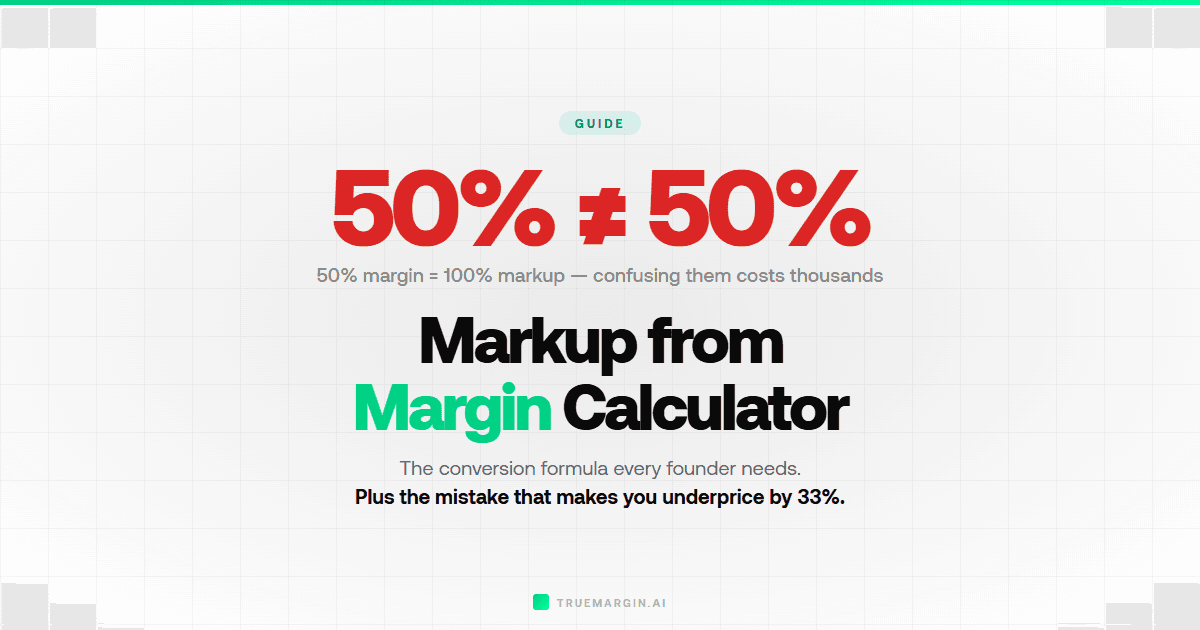
A 50% markup gives you $10 profit. A 50% margin gives you $20 profit. On the same $20 cost, confusing the two means underpricing by $10 per unit. Sell 1,000 units a month and that's $10,000 left on the table — every single month.
The rule: markup is always a higher number than margin for the same product. If someone quotes you a percentage and doesn't specify which one, ask. It matters.
Why 50% Margin Does NOT Equal 50% Markup
This trips up even experienced founders because 50% feels like 50%. But the math is unforgiving:
- 50% margin means the selling price is 2x the cost. A $10 product sells for $20. The markup is ($20 - $10) / $10 = 100%.
- 50% markup means you added half of the cost to the price. A $10 product sells for $15. The margin is ($15 - $10) / $15 = 33.3%.
A 50% margin requires a 100% markup. A 50% markup only produces a 33.3% margin. If you need a 50% margin to cover your operating expenses (ads, shipping, platform fees) and you accidentally apply a 50% markup instead, your actual margin is 33.3% — and you're likely losing money after all costs.
Full Markup-to-Margin Conversion Table
Bookmark this. You'll use it more than you think.
| Markup % | Margin % | Multiplier (Cost x ?) |
|---|---|---|
| 15% | 13.0% | 1.15x |
| 20% | 16.7% | 1.20x |
| 25% | 20.0% | 1.25x |
| 30% | 23.1% | 1.30x |
| 40% | 28.6% | 1.40x |
| 50% | 33.3% | 1.50x |
| 75% | 42.9% | 1.75x |
| 100% | 50.0% | 2.00x |
| 150% | 60.0% | 2.50x |
| 200% | 66.7% | 3.00x |
| 250% | 71.4% | 3.50x |
| 300% | 75.0% | 4.00x |
| 400% | 80.0% | 5.00x |
| 500% | 83.3% | 6.00x |
Key takeaway: Markup grows linearly but margin has diminishing returns. Doubling your markup from 100% to 200% only increases margin from 50% to 66.7%. Going from 200% to 300% only adds 8.3 margin points. You can never reach 100% margin no matter how high your markup goes.
Conversion Formulas: Markup to Margin and Back
Two formulas to memorize:
- Markup to Margin: Margin = Markup / (1 + Markup)
- Margin to Markup: Markup = Margin / (1 - Margin)
Example 1: You have a 150% markup (1.50 as a decimal). What's the margin? Margin = 1.50 / (1 + 1.50) = 1.50 / 2.50 = 0.60 = 60%.
Example 2: You want a 40% margin (0.40). What markup do you need? Markup = 0.40 / (1 - 0.40) = 0.40 / 0.60 = 0.667 = 66.7%.
These formulas work every time. No need to memorize the conversion table — just plug in the numbers. Or use our free profit margin calculator to convert instantly.
Stop converting markup and margin in your head.
Plug in your cost and selling price. Get your exact markup %, margin %, and profit per unit instantly — plus see how changes to your pricing affect your bottom line.
Open Profit Margin Calculator →Worked Examples: Real Ecommerce Products
Let's run through three realistic scenarios so you can see markup and margin working together on actual products.
Example 1: Skincare Serum
Cost to manufacture and ship to warehouse: $4.50. Selling price: $48.
- Markup = ($48 - $4.50) / $4.50 x 100 = 966.7%
- Margin = ($48 - $4.50) / $48 x 100 = 90.6%
- Profit per unit = $43.50
Beauty products typically have the highest markups in ecommerce. A 900%+ markup sounds absurd until you factor in $15-25 in ad spend per acquisition, $5 in shipping, $1.50 in platform fees, and $3-5 in returns per unit sold. After all that, your net margin is more like 25-35%. The high markup is what makes the business viable.
Example 2: Phone Case (Dropshipping)
Supplier cost (including shipping to customer): $6. Selling price: $24.99.
- Markup = ($24.99 - $6) / $6 x 100 = 316.5%
- Margin = ($24.99 - $6) / $24.99 x 100 = 76.0%
- Profit per unit (before ads) = $18.99
Dropshipping markups look great on paper. But ad costs eat most of it. If your CPA (cost per acquisition) is $12, your real profit per order drops to $6.99 — a 28% net margin. Still healthy for dropshipping. Use our dropshipping profit calculator to factor in all your real costs.
Example 3: Bluetooth Speaker
Cost (manufacturing + freight): $32. Selling price: $59.99.
- Markup = ($59.99 - $32) / $32 x 100 = 87.5%
- Margin = ($59.99 - $32) / $59.99 x 100 = 46.7%
- Profit per unit (before ads) = $27.99
Consumer electronics run on thinner markups. A sub-100% markup is typical. After $10-15 in ad spend, $5 shipping, and $2 in fees, your net profit is roughly $6-11 per unit — a 10-18% net margin. Tight, but workable if your average order value is high enough.
Recommended Markup by Industry
These are the typical markups you'll see in each ecommerce vertical. Use them as starting points — your actual markup depends on your specific COGS, competitive landscape, and how much you need to spend on ads. For detailed margin benchmarks, see our profit margin by industry breakdown.
| Industry | Typical Markup | Equivalent Margin | Notes |
|---|---|---|---|
| Beauty & Skincare | 150-400% | 60-80% | Highest in ecommerce. Low COGS, high perceived value. |
| Jewelry & Accessories | 100-300% | 50-75% | Materials are cheap relative to design and brand premium. |
| Supplements & Wellness | 150-250% | 60-71% | High repeat rates via subscriptions offset lower per-unit markups. |
| Fashion & Apparel | 100-200% | 50-67% | Watch return rates — they effectively reduce your real markup. |
| Home & Garden | 50-150% | 33-60% | Higher AOV compensates for lower markup percentages. |
| Pet Products | 100-200% | 50-67% | Emotionally driven buyers tolerate premium pricing. |
| Food & Beverage | 50-150% | 33-60% | Perishability and cold chain logistics eat into margins. |
| Consumer Electronics | 20-75% | 17-43% | Extreme price transparency limits what you can charge. |
| Dropshipping (general) | 100-400% | 50-80% | Need high markup to cover ad-heavy acquisition model. |
The minimum viable markup for paid-ads-driven ecommerce is roughly 100% (50% margin). Below that, your gross profit per unit is too thin to cover customer acquisition costs, shipping, platform fees, and still leave a profit. If your markup is under 100%, you need either very low acquisition costs or very high order volumes to survive.
How to Set Your Markup: Step by Step
Pricing isn't guesswork. Here's a systematic approach:
- Calculate your true COGS. Include product cost, packaging, inbound shipping, and any import duties. Most founders underestimate COGS by 10-15% because they forget about packaging and freight.
- Determine your required net margin. For most ecommerce brands, 10-20% net is the target. Below 10% is fragile. Above 20% is strong.
- Add back your operating expenses. Ad spend (15-25% of revenue), shipping to customer (8-12%), platform fees (2-5%), payment processing (2.5-3%), returns (2-8%). Total operating costs typically run 30-50% of revenue.
- Calculate required gross margin. Net margin target + operating expense % = required gross margin. Example: 15% net target + 35% operating expenses = 50% minimum gross margin needed.
- Convert to markup. Use the formula: Markup = Margin / (1 - Margin). A 50% margin needs a 100% markup. A 60% margin needs a 150% markup. A 70% margin needs a 233% markup.
- Reality-check against the market. Does your calculated selling price make sense for your niche? If your ideal markup gives you a $75 price point and competitors sell at $40, you either need to lower COGS, differentiate heavily, or pick a different product. Use our product pricing calculator to model different scenarios.
Common Markup Mistakes
Five pricing errors that cost ecommerce founders real money:
1. Confusing Markup and Margin
The classic. Your accountant says you need a 40% margin. You apply a 40% markup. Your actual margin is 28.6% — almost 30% less than what you needed. Over 10,000 orders at $50 average, that's $57,000 in lost profit.
2. Calculating Markup on Revenue Instead of Cost
Markup is calculated on cost. If you calculate it on selling price, you're actually calculating margin. This mistake usually happens when founders use a percentage and apply it to the wrong base number. Always check: am I dividing by cost (markup) or selling price (margin)?
3. Ignoring Variable Costs in COGS
Your COGS isn't just the supplier invoice. It includes packaging ($0.50-$2 per unit), inbound shipping ($0.50-$5 depending on weight and origin), customs duties (0-25% of declared value), and quality inspection costs. A product that costs $10 from the supplier might have a true COGS of $13-14 once you add everything. Your "200% markup" is really 140%.
4. Setting Markup Once and Forgetting It
Supplier costs change. Shipping rates change. Ad costs change. The markup you set at launch might be wrong six months later. Review your unit economics quarterly. If your CPA has increased 20% since launch, your markup needs to increase too — or your costs need to come down.
5. Using the Same Markup Across All Products
A flat 100% markup on everything sounds simple but it's lazy pricing. Your hero product that drives 60% of sales might need a 200% markup to cover ad spend. Your upsell product with zero acquisition cost can work at 80% markup. Price each product based on its role in your funnel — not a blanket rule.
Markup and Your Breakeven ROAS
Your markup directly determines your breakeven ROAS (return on ad spend). Higher markup means more gross profit per unit, which means you can afford to spend more on ads per sale and still break even.
The formula: Breakeven ROAS = 1 / Gross Margin. If your margin is 60% (150% markup), your breakeven ROAS is 1 / 0.60 = 1.67x. If your margin is 33% (50% markup), your breakeven ROAS is 1 / 0.33 = 3.03x.
Translation: With a 150% markup, you only need $1.67 in revenue for every $1 you spend on ads to break even. With a 50% markup, you need $3.03 for every $1. That's almost 2x harder. This is why low-markup products are so difficult to scale with paid ads — the math doesn't leave room for error.
Quick-Reference: Pricing Formulas
Every formula you need in one place:
| What You Want | Formula | Example |
|---|---|---|
| Markup % | (Price - Cost) / Cost x 100 | ($50 - $20) / $20 = 150% |
| Margin % | (Price - Cost) / Price x 100 | ($50 - $20) / $50 = 60% |
| Price from Markup | Cost x (1 + Markup%) | $20 x 2.50 = $50 |
| Price from Margin | Cost / (1 - Margin%) | $20 / 0.40 = $50 |
| Markup from Margin | Margin / (1 - Margin) | 0.60 / 0.40 = 150% |
| Margin from Markup | Markup / (1 + Markup) | 1.50 / 2.50 = 60% |
| Breakeven ROAS | 1 / Margin | 1 / 0.60 = 1.67x |
Next Steps
You now know how to calculate markup, convert it to margin, and set pricing that actually supports a profitable business. Here's where to go from here:
- Run your numbers. Use the free profit margin calculator to see your exact markup, margin, and profit per unit side by side.
- Model your pricing. The product pricing calculator lets you test different price points and see how they affect your margins and breakeven ROAS.
- Benchmark your industry. Check where your margins should land with our profit margin by industry data.
- Understand your AOV impact. Higher average order value means you can work with lower markups per product while maintaining healthy unit economics.
Frequently Asked Questions
What is the formula for markup?
Markup = (Selling Price - Cost) / Cost x 100. A product costing $20 that sells for $50 has a markup of ($50 - $20) / $20 x 100 = 150%. Markup is always calculated as a percentage of cost, not selling price.
What is the difference between markup and margin?
Markup is profit as a percentage of cost. Margin is profit as a percentage of selling price. A product that costs $40 and sells for $100 has a 150% markup but only a 60% margin. Same dollar profit, completely different percentages. Markup is always a higher number than margin for the same product.
How do I convert margin to markup?
Markup = Margin / (1 - Margin). If your margin is 40% (0.40), your markup is 0.40 / 0.60 = 66.7%. To go the other direction: Margin = Markup / (1 + Markup). If your markup is 66.7%, your margin is 0.667 / 1.667 = 40%.
Why is 50% margin not the same as 50% markup?
Different denominators. A 50% margin means half the selling price is profit — $10 cost sold for $20 (100% markup). A 50% markup means you added half the cost — $10 cost sold for $15 (33.3% margin). Confusing them means you're either overpricing or underpricing significantly.
What is a good markup for ecommerce products?
It depends on your industry. Beauty and skincare: 150-400% markup. Fashion: 100-200%. Electronics: 20-75%. The general rule is your markup needs to be high enough that after ad spend, shipping, platform fees, and returns, you still net 10-20% profit. For most ad-driven ecommerce, 100% markup (50% margin) is the minimum viable number.
How do I calculate selling price from cost and desired markup?
Selling Price = Cost x (1 + Markup%). If your cost is $25 and you want a 120% markup, the selling price is $25 x (1 + 1.20) = $25 x 2.20 = $55. To calculate from a desired margin instead: Selling Price = Cost / (1 - Margin%). For a 60% margin on a $25 cost: $25 / 0.40 = $62.50.