

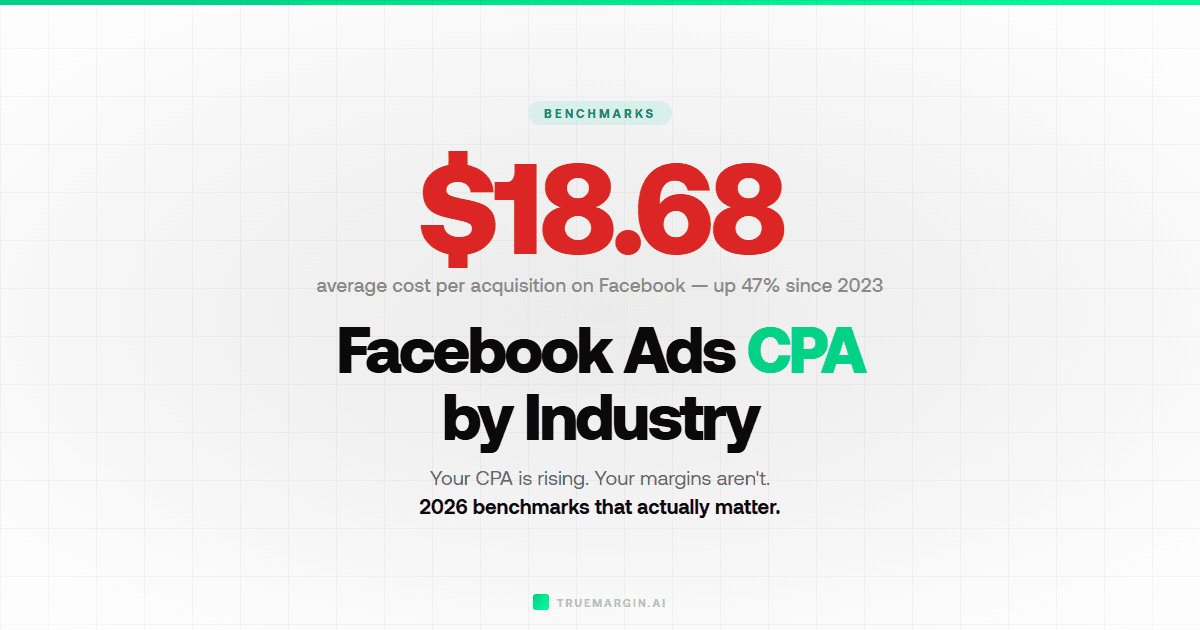
The average CPA for Facebook Ads across all industries is roughly $35-$40. That means the typical advertiser pays somewhere around $38 to acquire one customer through Meta (Facebook + Instagram) ads. But this number swings wildly — from under $30 in lifestyle niches to $50+ in electronics and finance.
Below are 2026 CPA benchmarks by ecommerce niche, the formula to calculate your target CPA, and what actually moves the needle when your acquisition costs are too high.
Facebook Ads CPA by Ecommerce Niche
These estimates are based on industry reports and aggregated benchmark data from ecommerce analytics platforms. All figures are approximate median CPAs for purchase-driven campaigns:
| Niche | Median CPA | YoY Change |
|---|---|---|
| Lifestyle & Boutique | ~$30 | - |
| Baby Products | ~$30 | - |
| Books & Media | ~$30 | - |
| Fashion & Apparel | ~$33 | Rising |
| Food & Beverage | ~$34 | Rising |
| Beauty & Personal Care | ~$35 | Rising |
| Home & Garden | ~$37 | Rising |
| Pet Products | ~$37 | Rising |
| Health & Wellness | ~$39 | Rising sharply |
| Sports & Outdoors | ~$39 | Rising |
| Business & Industrial | ~$41 | Rising |
| Finance | ~$44 | Rising |
| Travel & Luggage | ~$48 | Rising |
| Consumer Electronics | ~$49 | Rising |
CPAs are rising across the board. Health & wellness saw some of the sharpest increases, driven by more DTC brands entering the space. CPMs (cost per thousand impressions) have been rising as Meta absorbed more ecommerce ad spend — many brands now invest the majority of their ad budget on Meta.
Why CPA Varies So Much
The gap between $30 (lifestyle) and $49 (electronics) comes down to three factors:
- Price point. Lower-priced impulse products ($15-$40) convert faster, which means lower CPA. Higher-priced considered purchases ($200+) take more touchpoints, more retargeting, and more ad spend per conversion.
- Competition. Crowded niches (beauty, wellness) have more advertisers bidding on the same audiences, pushing up CPMs and CPAs. Niche categories with fewer advertisers enjoy lower auction costs.
- Conversion rate. CPA = CPC / conversion rate. If your landing page converts at 4% instead of 2%, your CPA drops by half — even if your CPC stays the same. Conversion rate is the single biggest CPA lever.
How to Calculate Your Target CPA
Industry benchmarks tell you what others pay. Your target CPA tells you what you can afford to pay. The formula:
Max CPA = Average Order Value × Profit Margin
| AOV | Profit Margin | Max CPA (breakeven) | Target CPA (profitable) |
|---|---|---|---|
| $30 | 60% | $18 | $9-$12 |
| $50 | 50% | $25 | $12-$17 |
| $75 | 60% | $45 | $22-$30 |
| $100 | 50% | $50 | $25-$35 |
| $150 | 65% | $97 | $48-$65 |
| $200 | 50% | $100 | $50-$70 |
Target CPA should be 50-70% of your max CPA. That leaves room for profit after accounting for returns, payment processing, and operational costs that aren't baked into your profit margin calculation.
If the industry benchmark CPA is higher than your max CPA, you have a unit economics problem — not an ad problem. Either raise your AOV (bundles, upsells), improve your margins, or increase customer lifetime value through repeat purchases.
Find your max CPA instantly.
Plug in your AOV, margins, and ad spend to see exactly what you can afford to pay per customer — and whether your current campaigns are profitable.
Open CPA Calculator →CPA vs CPC vs CPM (Which Metric Matters)
Three cost metrics, one that actually matters:
| Metric | What It Measures | Avg on Meta (2026) | Do You Care? |
|---|---|---|---|
| CPM | Cost per 1,000 impressions | $10-$18 | Only for awareness — not for ecom |
| CPC | Cost per click | $0.70-$1.50 | Useful but incomplete — clicks don't mean sales |
| CPA | Cost per actual purchase | $30-$50 | Yes — this is what determines profitability |
CPA is the only metric directly tied to your profit. A $0.50 CPC that drives window-shoppers who never buy is worse than a $2.00 CPC that drives qualified buyers with a $25 CPA. Optimize for CPA (or ROAS), not CPC.
What Actually Lowers Your CPA
Ranked by typical impact:
1. Landing Page Conversion Rate
A 1% improvement in landing page conversion can cut CPA by 25-50%. If your page converts at 2% and you improve it to 3%, your CPA drops by a third — same traffic, same ad spend, more sales. This is the most underleveraged CPA optimization.
2. Creative Quality and Freshness
Stale creatives = rising CPA. Meta's algorithm rewards fresh content. Brands that rotate creatives every 2-4 weeks tend to see significantly higher CTR, which directly reduces CPA. Test different hooks, formats (video vs. static vs. carousel), and angles simultaneously.
3. Audience Optimization
Lookalike audiences built from your best customers tend to significantly outperform interest-based targeting on CPA. Build lookalikes from: purchasers (best), high-AOV purchasers (even better), and repeat buyers (best of all). The higher the quality of the seed audience, the lower the CPA.
4. Campaign Objective
Using "Traffic" or "Engagement" objectives for ecommerce is leaving money on the table. Always use the "Sales" objective with "Purchase" as the conversion event. Meta's algorithm optimizes for what you tell it to — if you optimize for clicks, you'll get clickers, not buyers.
5. Offer Strength
The ad gets them to click. The offer gets them to buy. Free shipping, bundle discounts, money-back guarantees, and limited-time pricing can meaningfully reduce CPA because they increase your conversion rate at the point of purchase.
Facebook CPA vs Other Platforms
| Platform | Avg Ecom CPA | Best For |
|---|---|---|
| Facebook / Instagram | $30-$50 | Discovery, impulse buys, broad reach |
| Google Search | $25-$45 | High-intent buyers actively searching |
| Google Shopping | $20-$40 | Product-specific comparison shoppers |
| TikTok | $20-$45 | Gen Z, viral products, low-price impulse |
| $20-$45 | Home, fashion, aspirational products |
Google Shopping often delivers the lowest CPA because the buyer is already searching for the product. Meta's strength is volume — it can reach more potential customers than any other platform, which is why most ecommerce brands still allocate the majority of their ad budget there.
For a deeper breakdown of returns across platforms, see our Facebook Ads ROAS benchmarks.
2026 Trends Affecting CPA
- CPMs are rising year over year. More brands competing on Meta = higher costs. This pushes CPA up unless you're improving creative and conversion rate to compensate.
- Advantage+ campaigns are lowering CPAs. Meta's AI-driven campaigns reportedly reduce CPA compared to manual campaigns in many cases. Worth testing if you haven't already.
- First-party data is widening the gap. Brands with strong email lists and customer data are seeing meaningfully lower CPAs through better lookalike audiences and retargeting. Post-iOS privacy changes continue to penalize brands that rely solely on Meta's targeting.
- Video creative is non-negotiable. Short-form video ads (under 15 seconds) tend to deliver significantly lower CPA than static image ads. If you're still running mostly static creatives, you're likely overpaying for customers.
Advantage+ Shopping campaigns deserve a closer look. Meta's fully automated campaign type removes manual audience selection, placement choices, and most creative controls — the algorithm handles all of it. For ecommerce brands with a product catalog and the Meta pixel properly configured, Advantage+ Shopping often delivers lower CPAs than manual campaign structures because it tests more audience and placement combinations than any media buyer could manage by hand. The trade-off is transparency: you get less visibility into which audiences and placements are working, which makes it harder to build learnings you can apply elsewhere. The broader trend in 2026 is toward giving Meta's algorithm more room to optimize — broad targeting with no interest or lookalike restrictions, letting the creative and the pixel data do the targeting work. Brands that resist this and over-constrain their audiences tend to see higher CPAs as Meta's system fights against the restrictions.
Calculate Your CPA
Industry benchmarks are a starting point. What matters is your CPA relative to your unit economics. Use our free CPA calculator to see your max affordable CPA based on your actual margins and AOV.
Then check your ROAS benchmarks to see the full picture — CPA tells you the cost side, ROAS tells you the return side. You need both to know if your ads are working. And to model the impact of lowering your CPA on overall profitability, try our profit margin calculator.
Frequently Asked Questions
What is the average CPA for Facebook Ads?
The average CPA for Facebook Ads across all industries is roughly $35-$40 in 2025-2026. Ecommerce ranges from $30-$50 depending on niche. Lifestyle and baby products see the lowest CPAs (~$30), while electronics and finance are the most expensive ($44-$49+).
What is a good CPA for ecommerce Facebook Ads?
A good CPA depends on your margins. Calculate your max: AOV × profit margin = breakeven CPA. Then target 50-70% of that. A $60 product with 50% margins has a $30 max CPA — target $15-$20 for healthy profitability.
Why is my Facebook Ads CPA so high?
Common causes: stale creatives (refresh every 2-4 weeks), poor landing page conversion rate, wrong campaign objective (use Sales/Purchase, not Traffic), audiences that are too broad, or competing in an expensive niche.
How do I lower my Facebook Ads CPA?
Biggest levers: improve landing page conversion rate (1% improvement = 25-50% CPA drop), refresh creatives bi-weekly, use lookalike audiences from best customers, optimize for Purchase event, and strengthen your offer (free shipping, bundles, guarantees).
What is the difference between CPA and CPC?
CPC is cost per click. CPA is cost per actual purchase. CPA = CPC / conversion rate. A $1 CPC with a 3% conversion rate = $33 CPA. CPA is the metric that matters for profitability — cheap clicks mean nothing if visitors don't buy.