

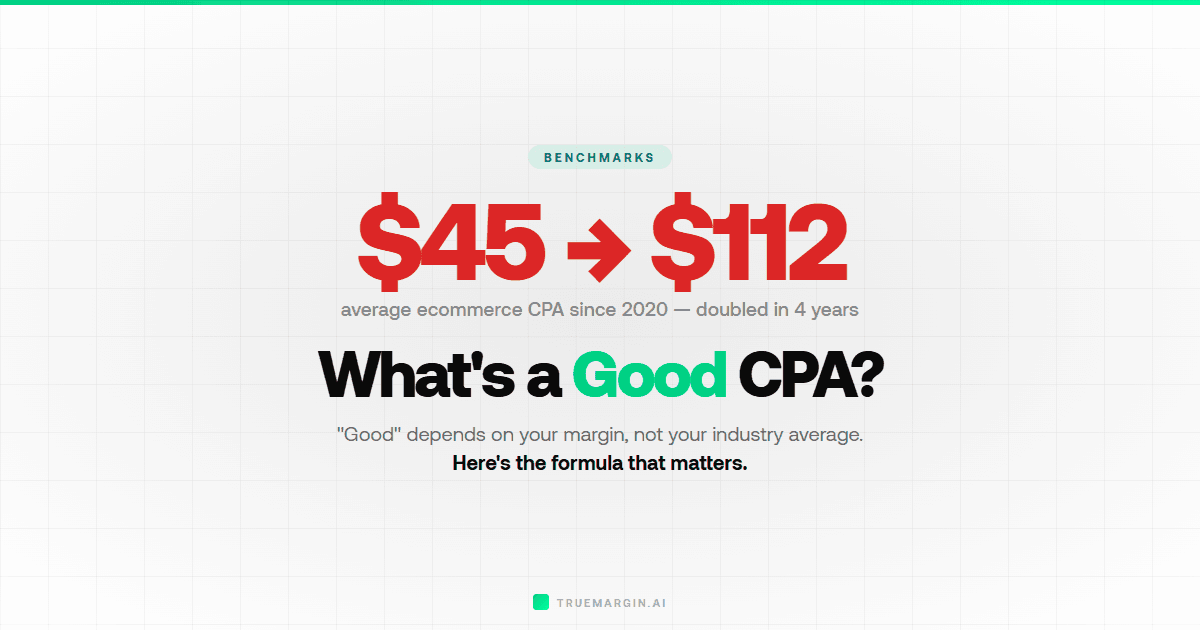
A good CPA for ecommerce is $30-$50. That's the industry median across paid channels in 2025-2026. But the number that actually matters is your target CPA — the maximum you can pay per customer and still make money. That depends entirely on your profit margins, not industry averages.
Below are CPA benchmarks by niche and platform, the formula to calculate your target CPA, the difference between CPA and CAC, and what actually moves the needle when acquisition costs are too high.
What CPA Means (and Why It Matters More Than CPC)
CPA stands for cost per acquisition — the amount you pay in advertising to generate one purchase. The formula is straightforward:
CPA = Total Ad Spend / Number of Purchases
Spend $5,000 on ads and get 100 orders? Your CPA is $50. CPA is the metric that connects your ad spend to actual revenue. CPC (cost per click) tells you what traffic costs; CPA tells you what customers cost. A $0.50 CPC that drives window-shoppers who never buy is worse than a $2.00 CPC that delivers a $30 CPA.
CPA Benchmarks by Ecommerce Niche (2026)
These figures are based on 2025-2026 data from Triple Whale (30,000+ ecommerce brands), WebFX, and cross-referenced industry reports. All figures are median CPA for purchase-optimized campaigns across paid channels:
| Niche | Median CPA | Typical AOV | AOV/CPA Ratio |
|---|---|---|---|
| Lifestyle & Boutique | $30 | $55-$80 | 2.2x |
| Baby Products | $30 | $50-$70 | 2.0x |
| Books & Media | $30 | $35-$55 | 1.5x |
| Fashion & Apparel | $33 | $65-$95 | 2.4x |
| Food & Beverage | $34 | $45-$65 | 1.6x |
| Beauty & Personal Care | $36 | $55-$80 | 1.9x |
| Home & Garden | $37 | $75-$120 | 2.6x |
| Pet Products | $37 | $50-$70 | 1.6x |
| Health & Wellness | $39 | $55-$85 | 1.8x |
| Sports & Outdoors | $39 | $80-$130 | 2.7x |
| Finance & Insurance | $44 | $100-$300 | 4.5x |
| Travel & Luggage | $48 | $90-$160 | 2.6x |
| Consumer Electronics | $49 | $120-$400 | 5.3x |
The AOV/CPA ratio is what separates profitable niches from margin traps. Sports & outdoors and home & garden maintain ratios above 2.5x, which provides room for COGS, shipping, and profit after acquisition costs. Books & media and food & beverage hover below 2x — viable only with high repeat-purchase rates or subscription models.
Health & wellness CPAs have risen sharply year-over-year, one of the steepest increases of any niche, driven by DTC supplement brands flooding Meta with ad spend. If you're in wellness, you need higher margins or stronger conversion rates than you did a year ago.
CPA Benchmarks by Ad Platform
The same product will have a different CPA depending on where you advertise. Here's what ecommerce brands are paying per platform in 2026:
| Platform | Avg Ecom CPA | Best For |
|---|---|---|
| Google Shopping | $20-$40 | Product comparison shoppers with high intent |
| Google Search | $25-$49 | Buyers actively searching for solutions |
| $20-$45 | Home, fashion, aspirational and visual products | |
| Facebook / Instagram | $30-$50 | Discovery, impulse buys, broad audience reach |
| TikTok | $25-$55 | Gen Z, viral products, sub-$50 impulse buys |
Google Shopping consistently delivers the lowest CPA because the buyer is already searching for the specific product. Meta (Facebook + Instagram) offers the most volume — most ecommerce brands allocate 60-70% of their ad budget there. TikTok has the widest CPA range: viral products can see sub-$15 CPAs, but considered purchases regularly exceed $50.
For a deeper breakdown of Meta-specific costs, see our Facebook Ads CPA benchmarks by industry.
How to Calculate Your Target CPA
Industry benchmarks tell you what others pay. Your target CPA tells you what you can afford to pay. Here's the formula:
Breakeven CPA = Average Order Value x Gross Profit Margin
Target CPA = Breakeven CPA x 0.5 to 0.7
The breakeven CPA is the absolute maximum you can spend to acquire one customer before you lose money on that order. The target CPA builds in a profit cushion — 50-70% of breakeven — to account for returns, payment processing, and operational costs that aren't baked into your margin calculation.
| AOV | Profit Margin | Breakeven CPA | Target CPA (50-70%) |
|---|---|---|---|
| $30 | 60% | $18 | $9-$13 |
| $50 | 50% | $25 | $13-$18 |
| $75 | 60% | $45 | $23-$32 |
| $100 | 50% | $50 | $25-$35 |
| $150 | 65% | $98 | $49-$68 |
| $200 | 50% | $100 | $50-$70 |
If the industry benchmark CPA for your niche is higher than your breakeven CPA, you don't have an ad problem — you have a unit economics problem. The fix is raising your AOV (bundles, upsells), improving your profit margins, or increasing customer lifetime value through repeat purchases and subscriptions.
Find your exact target CPA in 10 seconds.
Plug in your AOV, COGS, and ad spend to see your breakeven CPA, target CPA, and whether your current campaigns are profitable — or bleeding money.
Open CPA Calculator →CPA vs CAC: They're Not the Same Thing
These two metrics get used interchangeably, but they measure different things:
| Metric | What It Includes | Scope | Use Case |
|---|---|---|---|
| CPA | Ad spend only | Single campaign or channel | Evaluating ad performance |
| CAC | All sales & marketing costs (ads, salaries, tools, agencies) | Entire business | Evaluating overall acquisition economics |
CPA is tactical. CAC is strategic. Your Facebook CPA might be $35, but if you're also paying $3,000/month for an agency, $500 for analytics tools, and $2,000 for a content creator, your true CAC is much higher. The typical CAC across ecommerce tends to be roughly 3-4x the median CPA because it captures everything you spend to bring customers in, not just ad dollars.
When someone asks "what's a good CPA," they usually mean the ad-level metric. When an investor asks about your CAC, they want the full picture. Know both numbers.
6 Ways to Lower Your CPA
Ranked by typical impact from highest to lowest:
1. Improve Your Landing Page Conversion Rate
A 1% improvement in conversion rate can cut CPA by 25-50%. If your page converts at 2% and you push it to 3%, your CPA drops by a third — same traffic, same ad spend, more sales. This is the highest-leverage CPA fix because it multiplies the value of every dollar you spend on ads. Test your headline, hero image, social proof placement, and checkout flow. For benchmarks on what "good" looks like, check our ecommerce conversion rate data.
2. Refresh Ad Creatives Every 2-4 Weeks
Ad fatigue is real. When the same audience sees the same creative repeatedly, CTR drops and CPA climbs. Meta's algorithm rewards fresh content — brands that rotate creatives regularly tend to see significantly higher CTR. Test different hooks, formats (short-form video vs. static vs. carousel), and angles simultaneously. UGC-style video ads consistently outperform polished brand content on CPA.
3. Optimize Audience Targeting
Lookalike audiences built from your best customers typically outperform interest-based targeting significantly on CPA. Build lookalikes from purchasers (good), high-AOV purchasers (better), and repeat buyers (best). The higher the quality of the seed audience, the lower the CPA. First-party data matters more than ever — brands with strong email lists tend to see meaningfully lower CPAs through better lookalikes and retargeting.
4. Use the Right Campaign Objective
Running "Traffic" or "Engagement" campaigns for ecommerce is burning money. Always use the Sales objective optimizing for Purchase events. The algorithm optimizes for what you tell it to — if you optimize for clicks, you get clickers, not buyers. Meta's Advantage+ Shopping campaigns have been reportedly cutting CPAs meaningfully compared to manual campaigns for many brands.
5. Strengthen Your Offer
The ad gets the click. The offer gets the sale. Free shipping, bundle discounts, money-back guarantees, and limited-time pricing can meaningfully reduce CPA because they increase your conversion rate at the point of purchase. If your CPA is high and your CTR is fine, the problem is almost always the offer or the landing page — not the ad.
6. Diversify Across Platforms
CPMs on Meta rose significantly in 2025. If you're spending 100% of your budget on Facebook and Instagram, you're competing in the most expensive auction in ecommerce. Test Google Shopping (lowest CPA for search-intent buyers), TikTok (cheapest reach for sub-$50 products), and Pinterest (strong for visual, aspirational categories). Even shifting 20-30% of budget to a lower-CPA channel can reduce your blended acquisition cost meaningfully.
2026 Trends Pushing CPAs Higher
- Rising CPMs. Meta CPMs have climbed steadily year-over-year as more DTC brands compete for the same audiences. More advertisers in the auction = higher costs unless you compensate with better creative and conversion rates.
- Privacy changes are still biting. Post-iOS 14.5 attribution gaps haven't fully healed. Brands relying solely on Meta's native targeting (without first-party data) are paying a premium — notably higher CPAs than brands using customer data for lookalikes.
- CPA% is spiking. The percentage of revenue spent on acquisition has been climbing sharply. Brands are spending more to acquire the same customer.
- Video is non-negotiable. Short-form video ads (under 15 seconds) tend to deliver significantly lower CPA than static image ads. If you're still running mostly static creatives, you're overpaying for every customer.
When a "High" CPA Is Actually Fine
A $75 CPA sounds expensive until you learn the brand sells $300 products with 65% margins. Context matters. Your CPA is "good" if:
- It's below your breakeven CPA (you're profitable on the first order)
- It's below your customer LTV even if above breakeven (you profit over the customer lifetime)
- Your ROAS is healthy — CPA is the cost side, ROAS is the return side, and you need both
Subscription and consumable brands (supplements, coffee, skincare) can tolerate a first-order CPA above breakeven because they make it back on months 2-6. If your repeat-purchase rate is 40%+ and average customer lifetime is 4+ orders, your "max CPA" is really your LTV-based CPA, not your single-order breakeven.
Put It All Together
Industry benchmarks give you a baseline. Your target CPA — calculated from your own margins, AOV, and customer lifetime value — is the number that actually matters. Use our free tools to find yours:
- CPA Calculator — find your breakeven and target CPA based on your actual margins
- Profit Margin Calculator — verify your margins before calculating max CPA
- ROAS Calculator — see the return side of your ad spend
- Ad Budget Calculator — figure out how much to spend based on your revenue goals
Frequently Asked Questions
What is a good CPA for ecommerce?
The industry median is $30-$50, but a "good" CPA depends on your margins. Calculate your breakeven CPA (AOV x profit margin), then target 50-70% of that number. A $75 product with 60% margins has a $45 breakeven — target $23-$32 for healthy profitability.
What is the difference between CPA and CAC?
CPA measures the ad cost of a specific conversion (like a purchase) within a single campaign. CAC includes all sales and marketing expenses — ads, team salaries, tools, agency fees — divided by total new customers. CPA is a campaign-level metric; CAC is a business-level metric. Typical ecommerce CAC tends to be roughly 3-4x the median CPA because it captures the full cost of acquisition.
How do I calculate my target CPA?
Breakeven CPA = AOV x gross profit margin. Target CPA = breakeven CPA x 0.5 to 0.7. For example, a $100 AOV with 50% margins has a $50 breakeven. Target $25-$35 to leave room for returns, processing fees, and profit. Use our CPA calculator to run the math instantly.
What is the average CPA by ad platform?
In 2026, average ecommerce CPA by platform: Google Shopping $20-$40 (lowest, high intent), Google Search $25-$49, Pinterest $20-$45, Facebook/Instagram $30-$50, TikTok $25-$55 (widest range). Google Shopping tends to deliver the lowest CPA because shoppers are already searching for the product.
Why is my ecommerce CPA so high?
The most common causes: low landing page conversion rate (the biggest driver — a 1% improvement can cut CPA by 25-50%), stale ad creatives that haven't been refreshed in 4+ weeks, wrong campaign objective (use Sales/Purchase, not Traffic), weak offer, or competing in an expensive niche. Start by checking your conversion rate and creative freshness before adjusting targeting or budgets.