
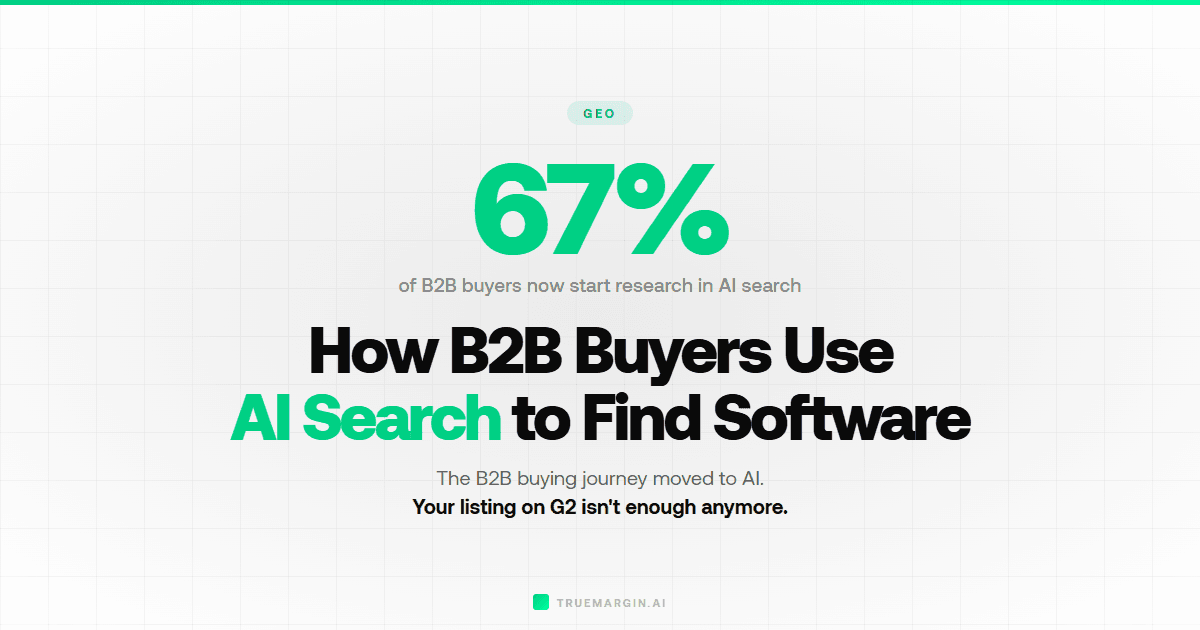
B2B software buyers are using ChatGPT, Perplexity, and Gemini to build shortlists before they ever talk to sales. They type "best CRM for a 50-person sales team" into an AI and get back 3-5 specific product recommendations with reasoning. No Googling. No scrolling through G2 pages. No clicking 10 ads. Just a direct answer with names attached.
If your SaaS isn't one of those names, you're not losing a ranking position. You're losing the conversation entirely. The buyer doesn't know you exist.
The scale of this shift is massive. ChatGPT now has 900 million weekly active users (TechCrunch), and AI referral traffic grew 1,200% year-over-year (Adobe Analytics). ChatGPT-referred traffic converts at 1.81% vs 1.39% for Google organic — a 31% lift (Search Engine Land). This guide breaks down exactly how B2B buyers use AI search to find software, what determines which products get recommended, and the specific steps you can take to make your SaaS visible in AI-generated answers. I think this is the most underpriced channel in B2B right now, and I'll explain why.
The B2B Buying Process Has Fundamentally Changed
The old B2B software buying journey looked like this: Google search, click a few ads, read review sites, download whitepapers, attend demos, negotiate with 5-8 vendors. It took weeks. Sometimes months.
The new journey is shorter. Much shorter.
A procurement lead or department head opens ChatGPT and types something like: "What are the best project management tools for a remote marketing agency with 20 people? We need time tracking, client portals, and Slack integration." The AI responds with 4-5 specific products, each with a paragraph explaining the fit. The buyer researches those 4-5 options. That's the shortlist. Everyone else is out.
Here's what makes this different from Google: there's no page two. Google shows 10 organic results plus ads, and a determined buyer might check page two or three. AI search returns a curated answer. If you're not in it, there's nowhere else to look. The buyer doesn't scroll. They don't click "show more." They take the list they got and move forward.
| Stage | Traditional B2B Buying | AI-Assisted B2B Buying |
|---|---|---|
| Discovery | Google search, ads, trade shows, referrals | Single AI prompt returns 3-6 recommendations |
| Shortlisting | Read G2/Capterra, compare 8-12 vendors | AI pre-filters to 3-6 options with reasoning |
| Evaluation | Request demos, read case studies, talk to sales | Follow-up AI prompts for deeper comparison |
| Timeline | 4-12 weeks | Hours to days for initial shortlist |
| Vendors considered | 8-12 initially, 3-4 finalists | 3-6 from the start, 2-3 finalists |
| Influence of paid ads | High (Google Ads, retargeting, sponsorships) | Near zero (only 1.6% of AI citations come from ads) |
This shift is accelerating. Gartner projected that by 2026, traditional search engine traffic would drop significantly as AI-powered answers replaced click-through behavior. We're now living in that prediction. For B2B SaaS founders who've built their entire acquisition strategy around Google Ads and SEO content, this is a rude awakening.
What Determines Which Software AI Recommends
AI systems don't pick favorites. They synthesize information from their training data and real-time web access to construct answers. The question isn't "how do I convince the AI?" It's "what does the AI have to work with when someone asks about my category?"
If the answer is "not much," you won't get recommended. Simple as that.
Here are the specific signals AI systems weigh when recommending B2B software:
| Signal | What AI Looks For | Why It Matters |
|---|---|---|
| Third-party reviews | G2, Capterra, TrustRadius listings with volume and recency | AI treats review platforms as authoritative reference sources |
| Community mentions | Reddit threads, Stack Overflow, Hacker News, niche forums | Authentic user discussions are weighted heavily in AI training data |
| YouTube presence | Reviews, tutorials, comparisons mentioning your product | YouTube accounts for 39.2% of AI citation sources (BrightEdge) |
| Comparison content | Articles like "[Your product] vs [Competitor]" with detailed breakdowns | Directly maps to the comparison queries buyers ask AI |
| Structured data | Schema markup, clear product descriptions, feature lists | Helps AI parse and categorize your product accurately |
| Expert endorsements | Blog posts, newsletters, and podcasts from practitioners | AI attributes higher authority to expert-written content |
| Integration mentions | Documentation showing "works with Slack, Salesforce, HubSpot" | Buyers ask AI about integrations; this matches those queries |
Notice what's not on the list: your ad spend. Only 1.6% of AI-cited URLs come from paid advertising (BrightEdge). You can't buy your way into AI recommendations the way you can buy Google's top spot. This is probably the most important thing B2B marketers need to internalize right now.
I'll be blunt: if your entire go-to-market is Google Ads and outbound SDRs, you're building on a channel that's shrinking while ignoring one that's exploding. That's not a strategy. It's inertia.
Why Most B2B SaaS Products Are Invisible to AI
Here's the uncomfortable truth. Most SaaS companies have optimized their entire web presence for one audience: Google's search algorithm. Every blog post targets a keyword. Every landing page is structured for ad quality score. Every piece of content exists to rank or convert.
None of that helps with AI visibility. Here's why.
Your marketing site is a closed loop. AI systems can read your marketing pages, but they treat self-promotional content with lower authority. When ChatGPT needs to recommend project management software, it doesn't weight your own "Why Choose Us" page the same as a Reddit thread where an actual user says "We switched to [Product X] six months ago and our team loves it." Third-party validation is the currency of AI recommendations.
You have no presence where AI trains. Research from BrightEdge shows that 88% of URLs cited by AI systems don't rank in Google's top 10. Your Google rankings and your AI visibility are essentially uncorrelated. The content that AI cites lives on YouTube (39.2% of citations), Reddit, forums, review sites, and expert blogs. If you don't exist in those places, AI has nothing to cite. To understand how this works in more detail, see our guide on what GEO is and why it matters.
Your content doesn't answer buying questions. B2B buyers ask AI specific, comparative questions: "What's better for a 200-person company, HubSpot or Salesforce?" or "Which helpdesk tool has the best Slack integration?" If your content doesn't directly address these comparison and use-case queries, AI won't surface you when those questions come up.
The AI Search Queries B2B Buyers Actually Type
Understanding the exact prompts buyers use is the key to showing up. These aren't vague searches. They're specific, context-rich questions that include company size, budget, integrations, and use case all in one prompt.
Category discovery: "What are the best [category] tools for [company size/type]?" This is the highest-volume query pattern. The buyer knows what they need but hasn't picked a vendor yet. Example: "Best expense management software for a 100-person startup."
Head-to-head comparison: "[Product A] vs [Product B] for [use case]." The buyer has a shortlist and wants help narrowing it down. If your product isn't one of the options they're comparing, you're already out. But if you've published thorough comparison content, AI will reference it when answering these queries.
Integration-specific: "Which [category] tool integrates best with [tool they already use]?" Extremely common in B2B because every company has an existing tech stack. Example: "Best CRM that integrates with Notion and Linear."
Use-case specific: "What software should I use to [specific workflow]?" These are the longest-tail queries, and they convert at the highest rate because the buyer has a specific problem. Example: "What tool can automatically sync our support tickets from Zendesk into Slack channels by priority?"
Budget-constrained: "Best [category] tool under $X/month for [team size]." Price is almost always part of the prompt. If your pricing isn't publicly available and well-documented, AI can't recommend you for budget-specific queries. This is a hard lesson B2B companies learn: hiding pricing hurts you in AI search.
The pattern is clear. Generic marketing content won't match these queries. You need content that addresses each dimension explicitly. For more on how AI engines process queries and form citations, check out our breakdown of how ChatGPT recommends products.
Is AI recommending your SaaS product?
Most B2B software companies have zero AI visibility and don't realize it. Our free tool checks whether ChatGPT, Perplexity, and other AI systems mention your product when buyers ask category-level questions.
Check Your AI Visibility Score →How to Make Your B2B SaaS Visible in AI Search
This isn't theory. These are the specific actions that move the needle on AI citations for B2B software products.
1. Dominate Review Platforms With Fresh, Detailed Reviews
G2, Capterra, and TrustRadius are primary reference sources for AI systems when answering B2B software questions. But volume alone isn't enough. AI weighs recency and specificity. A review from 2024 that says "Great tool, love it" carries far less weight than a review from this month that says "We migrated our 40-person sales team from Salesforce and cut our CRM spend by 35% while keeping pipeline visibility."
Action: Build a systematic review generation program. After every successful onboarding, ask customers to leave a detailed G2 review. Give them a template that prompts for specifics: company size, previous tool, results, integrations used. Aim for a minimum of 10 new reviews per quarter.
2. Create Comparison Content for Every Competitor
When a buyer asks AI "[Your Product] vs [Competitor]," the AI needs content to reference. If the only comparison content is on your competitor's blog, guess who gets positioned favorably?
Action: Publish a dedicated comparison page for each of your top 5-10 competitors. Include feature-by-feature breakdowns, pricing comparisons (be honest about where competitors win too), ideal customer profiles for each, and migration paths. Honest comparison content gets cited more than biased marketing pages because AI systems can detect when a comparison is one-sided.
3. Build Real Presence on Reddit
Reddit data is literally baked into AI training sets. Google paid $60M and OpenAI paid $70M+ for Reddit data access. When someone in r/SaaS, r/startups, or a niche industry subreddit says "We've been using [Product X] for a year and it's been great for [use case]," that comment trains the model to recommend Product X.
Action: Identify the 5-10 subreddits where your buyers hang out. Have team members (founders, engineers, customer success) contribute genuine value to discussions. When your product is genuinely the right answer to someone's question, recommend it with real context and results. Don't astroturf. AI models are trained on upvoted, authentic content. Spam gets downvoted and filtered out. For a deeper look at how Reddit feeds into AI citations, read our piece on Reddit's role in AI-generated citations.
4. Invest in YouTube Content
YouTube accounts for 39.2% of all AI citation sources (BrightEdge), and that number doubled in just four months. AI models index video transcripts, meaning what's said in a YouTube video about your product directly influences AI recommendations.
Action: Create (or sponsor) YouTube content in three formats: product walkthroughs and tutorials, head-to-head comparisons with competitors, and use-case-specific demos ("How to set up automated reporting in [Your Product] for a marketing agency"). Make sure your product name is mentioned naturally multiple times in the audio. Transcripts are what AI reads.
5. Publish Integration Documentation Publicly
Integration queries are among the most common B2B AI prompts. "Which [category] tool works best with [existing tool]?" If your integration docs live behind a login wall or are buried in a help center, AI can't reference them.
Action: Create a public integrations page that lists every integration with detailed descriptions of what each one does. Include specific capabilities, not just "integrates with Slack." Say "Sends real-time notifications to Slack channels when deals close, with customizable triggers by deal size, stage, or owner." This level of specificity is what AI needs to match your product to integration-specific queries.
6. Make Pricing Transparent
In my opinion, hiding pricing is one of the biggest AI visibility mistakes B2B SaaS companies make. When a buyer asks "best CRM under $50/user/month," AI can only recommend products with publicly available pricing. If your pricing page says "Contact sales," you're invisible to every budget-constrained query. And nearly all B2B AI queries include a budget constraint.
Action: Publish your pricing publicly with clear per-user or per-seat breakdowns. Include a pricing comparison table on your comparison pages. If you genuinely can't publish exact pricing, at least publish starting prices and ranges so AI has something to work with.
7. Monitor and Iterate With an AI Visibility Score
You can't optimize what you can't measure. Use our AI Authority Checker to establish a baseline. See which AI systems currently mention your product, which competitors show up instead, and which buying queries you're missing. Then track your score monthly as you implement these tactics. For context on how these scores work, see our explanation of the AI visibility score methodology.
A 90-Day AI Visibility Playbook for B2B SaaS
Here's a concrete timeline for going from invisible to cited. This isn't everything you could do. It's the minimum effective dose.
| Timeline | Action | Expected Impact |
|---|---|---|
| Week 1 | Run your AI visibility baseline check | Know exactly where you stand across ChatGPT, Perplexity, Gemini, Claude |
| Weeks 1-2 | Publish comparison pages for your top 5 competitors | Gives AI reference content for head-to-head queries |
| Weeks 2-4 | Launch a G2 review campaign (target 15+ new reviews) | Fresh, detailed reviews feed directly into AI training data |
| Weeks 3-6 | Create 3 YouTube videos (walkthrough, comparison, use-case demo) | Taps into the 39.2% AI citation source |
| Weeks 4-8 | Build authentic Reddit presence in 5 relevant subreddits | Seeds brand mentions in AI training sets |
| Weeks 6-10 | Publish public integration docs and transparent pricing page | Makes you eligible for integration and budget queries |
| Week 12 | Re-run AI visibility check and compare to baseline | Measure progress and identify remaining gaps |
Total investment: about 40-60 hours of content work spread across 90 days. That's less than what most B2B SaaS companies spend on a single quarter of Google Ads management. The difference? These assets compound. Every comparison page, every review, every Reddit thread stays in the AI's reference data and keeps working for you indefinitely.
Why This Window Won't Stay Open
Right now, most B2B SaaS companies have zero AI visibility strategy. They're still spending 100% of their marketing budget on Google Ads, SEO content, and outbound SDRs. That creates an enormous opportunity for companies that move first.
But the window is closing. Here's why.
AI citations compound like SEO used to. The brands that show up in AI answers today get talked about more, which generates more third-party content, which makes AI more likely to cite them tomorrow. It's a flywheel. Once your competitor establishes AI presence, displacing them becomes exponentially harder. Just like it took years to unseat entrenched SEO players, it'll take years to unseat entrenched AI-cited brands.
Awareness is growing fast. Eighteen months ago, nobody in B2B marketing was talking about GEO. Now it's a conference topic, agencies are offering it as a service, and the early adopter window is shrinking. The companies acting in Q1-Q2 2026 have a genuine first-mover advantage. By Q4, this will be table stakes.
I honestly believe AI visibility will be the single biggest differentiator for B2B SaaS distribution in the next two years. Bigger than SEO. Bigger than paid ads. The buying behavior shift is that fundamental.
Common Mistakes B2B SaaS Companies Make With AI Visibility
Treating it like SEO. AI visibility isn't about keywords, backlinks, or domain authority. Stuffing your blog posts with target keywords doesn't help AI models recommend your product. They care about whether authoritative sources across the web mention you in the right context.
Only optimizing their own site. Your marketing site is one data point among millions that AI considers. If that's your only presence, you're outnumbered. The brands that win AI visibility have distributed presence: reviews, Reddit, YouTube, comparison articles, practitioner blogs, community forums. It's a breadth game.
Ignoring YouTube. At 39.2% of AI citations and growing, YouTube is the single most important platform for AI visibility. Most B2B SaaS companies don't invest in video at all. That's like ignoring Google in 2005. The opportunity cost is staggering.
Faking social proof. AI models are trained on authentic content. Fake Reddit accounts, astroturfed reviews, and bot-generated comments get downvoted, flagged, and filtered. Worse, platforms like G2 actively penalize fake reviews. The only sustainable strategy is genuine user advocacy.
Waiting for perfect data. Some teams want to see more research before investing in AI visibility. The data is already here. Gartner predicted the shift. BrightEdge quantified it. And every day, more B2B buyers are typing purchase queries into ChatGPT instead of Google. Waiting for "more data" is just another way of saying "let our competitors go first."
Frequently Asked Questions
How are B2B buyers using AI search to find software?
B2B buyers are prompting ChatGPT, Perplexity, Gemini, and Claude with queries like "best CRM for 50-person sales team" or "top project management tools for remote agencies." The AI returns a short list of 3-6 recommended products with explanations of why each fits. This is replacing the traditional process of Googling, reading G2 reviews, and attending demos from 10+ vendors.
Why doesn't my SaaS show up in AI search results?
AI systems cite brands that appear in authoritative, structured third-party content across the web. If your SaaS only has a marketing website and a few blog posts, AI models have very little to reference. You need presence on review platforms, comparison articles, Reddit discussions, YouTube reviews, and community forums where practitioners mention your product by name.
Does traditional SEO help with AI visibility for B2B SaaS?
Barely. 88% of URLs cited by AI systems don't rank in Google's top 10 (BrightEdge). SEO rankings and AI citations are nearly uncorrelated. A SaaS product can rank #1 on Google for its category and still be completely absent from ChatGPT's recommendations. They require different optimization strategies.
What content types do AI systems cite most for B2B software?
YouTube content accounts for 39.2% of AI citation sources (BrightEdge), making it the single largest source. Reddit threads, authoritative comparison articles, review platform listings (G2, Capterra), and practitioner-written blog posts with real usage data make up most of the rest. Paid ads account for only 1.6% of AI citations.
How can I check if AI systems recommend my SaaS product?
Use our free AI Authority Checker to query multiple AI models with category-specific buying prompts and measure whether your product appears in the responses. It takes about 5 minutes and gives you a concrete baseline score across ChatGPT, Perplexity, Gemini, and Claude.
How long does it take for AI visibility efforts to show results for B2B SaaS?
Some changes show up within days. New Reddit threads and YouTube videos indexed by Perplexity can appear quickly. Broader model training updates from OpenAI or Google typically happen on a quarterly cycle. Most B2B SaaS companies that implement a focused AI visibility strategy see measurable improvements in citations within 60-90 days.