
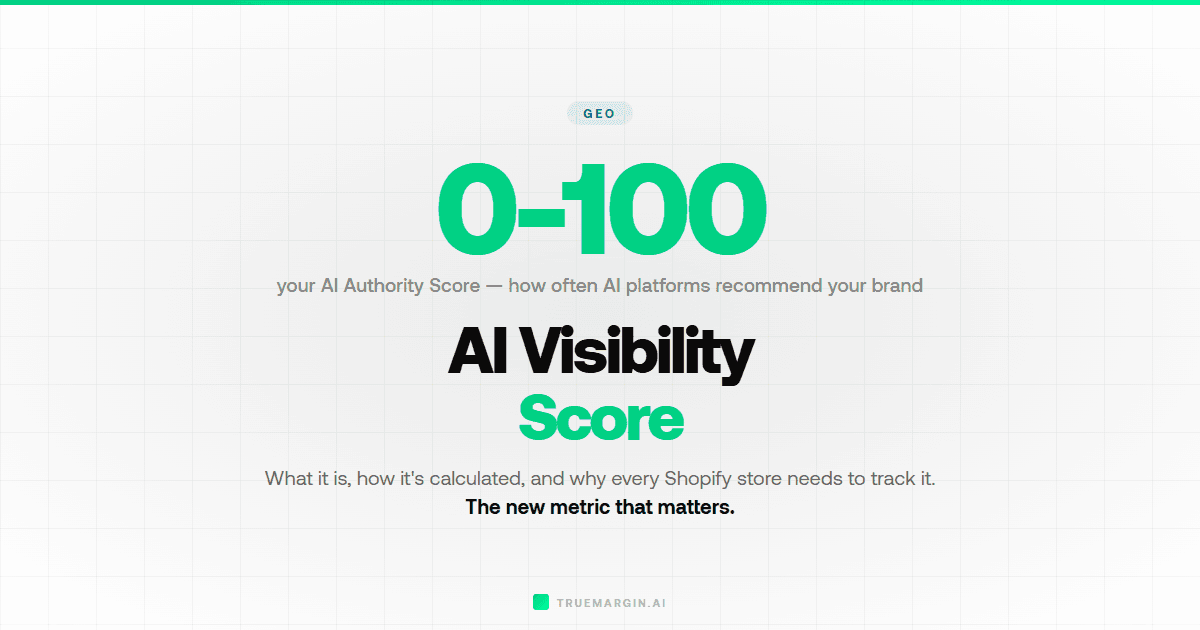
An AI Visibility Score measures how likely your brand is to be recommended by AI systems like ChatGPT, Perplexity, Gemini, and Claude. Think of it as the GEO equivalent of Domain Authority. Domain Authority predicts how well you'll rank in Google. AI Visibility Score predicts how often AI will mention you when someone asks "what's the best [your category] brand?"
This matters right now because ChatGPT has hit 900 million weekly active users (TechCrunch), and 88% of URLs cited by AI systems do NOT rank in Google's top 10 (BrightEdge). Traditional SEO rankings and AI recommendations are almost entirely disconnected. Your store could rank #1 on Google and never get mentioned by ChatGPT — or rank nowhere and get recommended constantly.
If you're running a Shopify store and you don't know your AI Visibility Score, you're flying blind on what's quickly becoming the most important discovery channel in ecommerce. You can check your AI visibility score for free here.
Why AI Visibility Is the New Domain Authority
Domain Authority was the metric that defined SEO for a decade. It gave you a single number that predicted your ability to rank. AI Visibility Score does the same thing for Generative Engine Optimization (GEO) — it gives you a single number that predicts your ability to get recommended by AI.
But the inputs are completely different. Domain Authority is driven by backlinks. AI Visibility Score is driven by brand mentions, content depth, third-party citations, and presence on AI training sources. The two metrics are nearly independent — which is why most Shopify stores that dominate Google are invisible to AI, and vice versa.
Here's why this shift is happening:
- Shopify announced ChatGPT integration in 2025. AI-powered shopping is not theoretical — it's already a native commerce channel. AI referral traffic grew 1,200% year-over-year (Adobe Analytics), and 64% of consumers plan to use AI for shopping in 2026 (Capital One Shopping).
- Almost none of the URLs AI cites come from paid ads (BrightEdge). You can't buy your way into AI recommendations. This is an organic game.
- YouTube content accounts for 39.2% of AI citation sources (BrightEdge), and that number doubled in four months. The sources AI pulls from are not the same sources Google ranks.
For a full breakdown of how GEO differs from traditional SEO, read our comparison guide. The short version: if you're only optimizing for Google, you're optimizing for yesterday's discovery channel.
How an AI Visibility Score Is Calculated
AI systems don't use a single ranking signal. They synthesize information from across the web to decide which brands to recommend. An AI Visibility Score attempts to quantify the inputs that matter most. Here are the core factors:
| Factor | What It Measures | Why It Matters for AI |
|---|---|---|
| Brand Mentions | How often your brand appears across the web (forums, articles, reviews) | AI models surface brands they've seen frequently in training data |
| Content Depth | Topical coverage, word count, expertise signals on your site | Deeper content gives AI more context to cite you as an authority |
| Third-Party Citations | Editorial mentions, reviews, roundups on other sites | Independent validation is weighted heavily by AI recommendation logic |
| AI Training Source Presence | Visibility on Reddit, YouTube, forums, Wikipedia | These sources are disproportionately used in AI training datasets |
| Structured Data | Schema markup, product data, FAQ schemas on your site | Structured data makes it easier for AI to extract and reference your information |
| Review Signals | Volume, recency, and sentiment of customer reviews | AI systems factor in social proof when making recommendations |
| Brand Consistency | Uniform brand name, messaging, and claims across all channels | Conflicting information reduces AI confidence in recommending you |
Not all factors carry equal weight. The next section breaks down how heavily each source type contributes to AI citations.
Platform Weight by AI Citation Source
BrightEdge research shows a clear hierarchy in where AI systems pull their citations from. This data tells you where to focus your efforts:
| Citation Source | Share of AI Citations | Trend | Implication for Shopify Stores |
|---|---|---|---|
| YouTube | 39.2% | Doubled in 4 months | Product reviews, demos, and comparison videos are high-value |
| High (exact % varies) | $130M+ in AI training deals | Authentic community mentions carry outsized weight | |
| Editorial / News Sites | Data varies | Stable | PR and earned media directly feed AI recommendations |
| Forums / Q&A | Data varies | Growing | Quora, niche forums, Stack Exchange all get ingested |
| Paid Ads | Negligible | Flat / negligible | You cannot buy AI visibility — it's almost entirely organic |
The takeaway: YouTube and Reddit together likely account for the majority of AI citation sources. Reddit alone has signed $130M+ in AI training data licensing deals ($60M with Google, $70M+ with OpenAI). If your brand isn't being discussed on these platforms, AI systems have very little to work with when someone asks for a recommendation in your category.
This is a fundamentally different playbook than traditional SEO. Backlinks from niche blogs don't move the needle here. For more on this shift, see our guide on how to get your Shopify store recommended by AI.
AI Visibility Score Ranges: What They Mean
When you run your brand through an AI visibility checker, the score typically falls into one of these ranges. Here's what each means and what you should do about it:
| Score Range | Rating | What It Means | Recommended Action |
|---|---|---|---|
| 0 – 20 | Invisible | AI systems have almost no data about your brand. You won't be recommended. | Start with foundational brand mentions — Reddit, YouTube, review sites. Build from zero. |
| 21 – 40 | Low | AI may know your brand exists but won't recommend it with confidence. | Increase third-party citations. Get editorial coverage. Publish depth content. |
| 41 – 60 | Moderate | AI occasionally recommends you but not consistently. You show up for some queries. | Double down on the channels already working. Fill content gaps in your category. |
| 61 – 80 | Strong | AI recommends you regularly for relevant queries. You're a recognized player. | Optimize for adjacent categories. Expand to new AI platforms. Defend your position. |
| 81 – 100 | Dominant | AI systems consistently recommend you as a top choice. You own your category. | Monitor competitors. Maintain content freshness. Expand into related verticals. |
Most Shopify stores we've scanned fall in the 0–30 range. That's not surprising — most store owners haven't thought about AI visibility at all. But it also means there's a massive first-mover advantage. The stores that build AI visibility now will be the ones AI recommends by default for years to come.
Want to know where your store stands?
Our free AI Authority Checker scans your brand across the signals that matter and returns your AI Visibility Score in seconds. No signup required.
Check Your AI Visibility Score Free →The 88% Gap: Why Google Rankings Don't Predict AI Recommendations
This is the single most important stat for Shopify store owners to understand: 88% of URLs cited by AI systems do NOT rank in Google's top 10 (BrightEdge). That means the pages AI chooses to reference are almost entirely different from the pages Google ranks.
Why? Because Google and AI systems use fundamentally different logic:
- Google ranks pages. It evaluates backlinks, on-page SEO, and technical factors to decide which page deserves a top position for a query.
- AI recommends brands. It synthesizes information from across the entire web — YouTube, Reddit, reviews, forums, news articles — to decide which brand to mention in a conversational answer.
A Shopify store with zero backlinks but strong Reddit presence, hundreds of YouTube reviews, and consistent brand mentions across forums can have a higher AI Visibility Score than a store that ranks #1 for its main keywords on Google.
This is why tracking your conversion rate and ROAS benchmarks isn't enough anymore. You need to measure your AI visibility as a separate metric — because the traffic coming from AI recommendations behaves differently than search traffic or paid traffic.
What Shopify's ChatGPT Integration Means for AI Visibility
Shopify announced a ChatGPT integration in 2025, making it possible for shoppers to discover and purchase Shopify products directly through AI conversations. This turned AI recommendations from a branding play into a direct revenue channel.
When a shopper asks ChatGPT "what's the best organic skincare brand on Shopify?" — and ChatGPT recommends your store — that's a sale you didn't pay for. No ad spend. No SEO effort. Just brand presence feeding into AI output. And the economics are compelling: ChatGPT-referred traffic converts at 1.81% vs 1.39% for Google organic, a 31% higher conversion rate (Search Engine Land), with revenue per session running $3.65 vs $3.30 (Visibility Labs).
But here's the catch: almost none of the URLs AI cites come from paid ads. You can't run ChatGPT ads to get recommended. This is purely organic. Either AI knows about your brand, or it doesn't. Your AI Visibility Score tells you which side you're on.
For a deeper look at how this integration works and what it means for your store, read our guide to ChatGPT and Shopify product recommendations.
How to Improve Your AI Visibility Score
Improving your AI Visibility Score is not about traditional SEO tactics. It's about building the kind of brand presence that AI systems can detect and trust. Here's the playbook, ranked by impact:
1. Get Mentioned on YouTube
YouTube content accounts for 39.2% of AI citation sources, and that share doubled in just four months (BrightEdge). This is the single highest-leverage channel for AI visibility right now.
Send products to reviewers. Create comparison videos. Get featured in "best of" roundups. Every YouTube mention is a data point that AI systems ingest and use when generating recommendations.
2. Build Reddit Presence
Reddit has signed $130M+ in AI training data licensing deals — $60M with Google and $70M+ with OpenAI. Reddit threads are directly fed into AI training pipelines. When your brand gets mentioned authentically in subreddit discussions, that data flows directly into the models.
Don't spam. Engage genuinely in relevant communities. Answer questions. Share expertise. The goal is authentic brand mentions in contextually relevant threads.
3. Earn Editorial Coverage
Third-party editorial mentions — product roundups, news articles, expert reviews — carry significant weight. AI systems treat independent validation as a trust signal. One "best Shopify stores for [category]" article on a credible publication can move your score meaningfully.
4. Publish Expert-Depth Content
Thin content gets ignored by AI. Deep, authoritative content on your core topics gives AI systems more material to draw from when generating answers. Think guides, comparisons, data-driven posts — the kind of content that answers specific questions in depth.
This is where a strong blog strategy pays double dividends. Your content works for both GEO and SEO simultaneously.
5. Implement Structured Data
Schema markup (Product, FAQ, Review, Organization schemas) makes your information machine-readable. AI systems can extract structured data more easily and accurately than unstructured content. Every Shopify store should have comprehensive schema on product pages, FAQ pages, and the homepage.
6. Maintain Brand Consistency
If your brand name, product claims, or messaging differ across platforms, AI systems lose confidence. Conflicting information leads to lower recommendation probability. Audit your brand presence across every platform and make sure it's consistent.
AI Visibility Score vs. Other Metrics
How does AI Visibility Score compare to the metrics you already track? Here's the breakdown:
| Metric | What It Predicts | Primary Inputs | Overlap with AI Visibility |
|---|---|---|---|
| Domain Authority | Google search rankings | Backlinks, linking domains | Low (only 12% overlap in cited URLs) |
| ROAS | Ad efficiency | Ad spend, revenue | None (AI rarely cites paid ads) |
| Conversion Rate | On-site purchase probability | UX, pricing, trust | Indirect (AI-referred traffic may convert differently) |
| Brand Search Volume | Brand awareness | Marketing, PR, word of mouth | Moderate (brand awareness and AI visibility are correlated but not identical) |
| AI Visibility Score | AI recommendation frequency | Brand mentions, YouTube, Reddit, reviews, structured data | N/A — this is the metric |
The key insight: AI Visibility Score fills a gap that no existing metric covers. Your store revenue benchmarks, your ROAS targets, your conversion rate — none of these tell you whether AI systems know your brand exists. That's the blind spot this metric fills.
How to Check Your AI Visibility Score
We built the AI Authority Checker to make this simple. Enter your brand or domain, and it scans the signals that AI systems actually use to generate recommendations. You get:
- An overall AI Visibility Score from 0 to 100
- Factor-by-factor breakdown showing where you're strong and where you're invisible
- Comparison to your category so you know where you stand relative to competitors
- Actionable recommendations ranked by impact
It's free. No signup required. Takes about 30 seconds.
If your score is lower than you'd like, that's normal — most stores haven't started optimizing for AI yet. The important thing is knowing where you stand so you can start building.
For stores that want to go beyond manual fixes, our Autopilot tool can automate your GEO strategy — handling content optimization, structured data, and AI visibility signals on autopilot.
The First-Mover Advantage Is Real
AI Visibility Score is where Domain Authority was in 2010. Most businesses don't know it exists. The ones that do are building an unfair advantage that compounds over time.
AI models learn from the web as it exists today. The brands that build presence now become the defaults AI recommends for years. Once an AI system has a strong association between your brand and a product category, it's extremely difficult for competitors to displace you — much harder than outranking someone on Google.
This is especially true for Shopify stores. The ChatGPT + Shopify integration means AI recommendations are already a direct shopping channel. Every day you wait is a day your competitors could be building the AI presence that makes them the default recommendation in your category.
Bottom Line
AI Visibility Score is the single most important new metric for Shopify store owners in 2026. It tells you something no other metric can — whether AI systems will recommend your brand when shoppers ask for help.
The data is clear: 88% of AI-cited URLs don't rank in Google's top 10. Almost none come from paid ads. YouTube alone drives 39.2% of citations. This is a completely different game than SEO or paid acquisition, and it requires a completely different metric.
Check your AI Visibility Score for free and find out where you stand. Then read our guide on how to get your Shopify store recommended by AI to start improving it.
FAQ
What is an AI Visibility Score?
An AI Visibility Score measures how likely your brand is to be recommended by AI systems like ChatGPT, Perplexity, Gemini, and Claude. It evaluates factors including brand mentions, content depth, structured data, third-party citations, and presence on AI training sources like Reddit and YouTube.
Why does AI visibility matter for Shopify stores?
AI systems are becoming a primary product discovery channel. Shopify integrated ChatGPT in 2025, turning AI recommendations into a direct shopping path. Stores with higher AI visibility get recommended more often — and this traffic is free. Almost none of the URLs AI cites come from paid ads.
How is the score calculated?
It analyzes multiple signals: brand mentions across the web, presence on AI training data sources (Reddit, YouTube, forums), content authority, structured data quality, third-party reviews and editorial coverage, and brand consistency. Each factor is weighted by how heavily AI models rely on it.
Can I check my score for free?
Yes. True Margin's AI Authority Checker scans your brand and returns an AI Visibility Score with a detailed breakdown. No signup required.
What's the difference between AI Visibility Score and Domain Authority?
Domain Authority predicts Google search rankings based on backlink profiles. AI Visibility Score predicts how often AI systems will recommend your brand. BrightEdge research shows 88% of AI-cited URLs don't rank in Google's top 10 — the two metrics measure almost entirely different things.
How do I improve my AI Visibility Score?
Focus on YouTube (39.2% of AI citations), Reddit ($130M+ in AI training deals), editorial coverage, expert-depth content, structured data, and brand consistency. For a complete walkthrough, read our guide on getting your Shopify store recommended by AI.