

The Quick Number
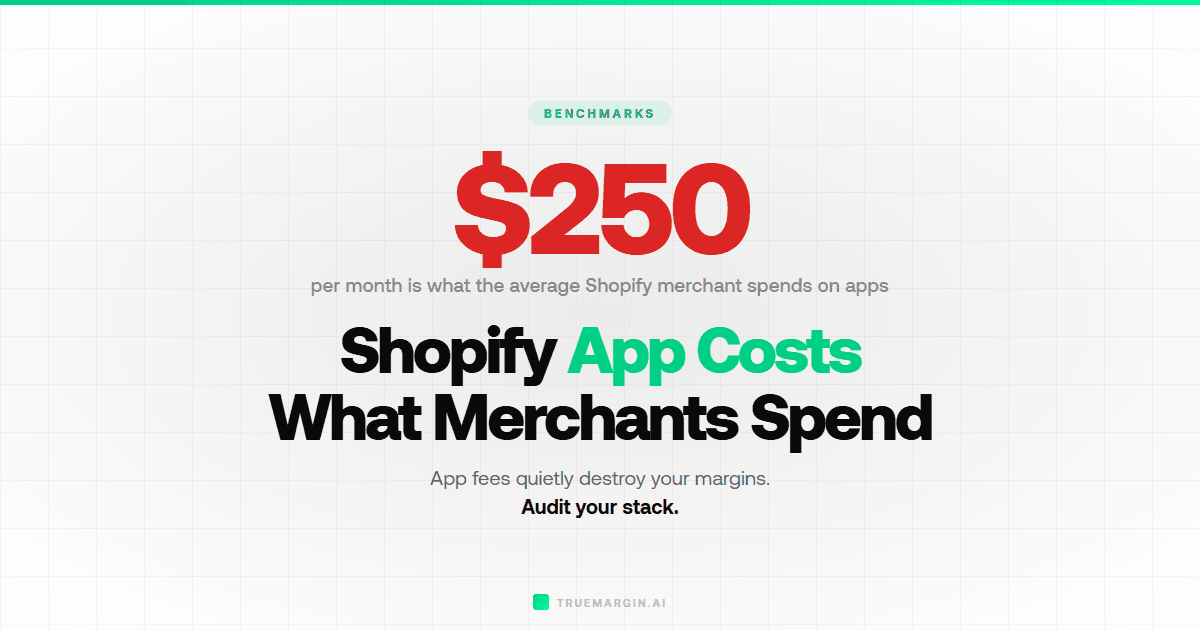
The average Shopify merchant spends $120 per month on apps. Most stores land somewhere between $30 and $300, depending on how many operations they've automated and how big their order volume is. The average app itself costs $58.49/month across all plan tiers.
That might sound like a lot until you realize 87% of Shopify merchants use apps, and the average store runs 6 of them. Some run 30. Apps aren't optional on Shopify. They're how you fill the gaps that the core platform doesn't cover.
The real question isn't "how much do apps cost" but "which ones are actually worth paying for."
App Costs by Category
Not all app categories hit your wallet the same way. Email marketing eats the biggest chunk for most stores because pricing scales with your contact list. Review apps are cheap. Analytics tools sit somewhere in the middle.
| App Category | Typical Monthly Cost | Popular Examples |
|---|---|---|
| Email Marketing | $20-$100+ | Klaviyo, Omnisend, Shopify Email |
| Reviews / UGC | $15-$50 | Judge.me, Loox, Stamped |
| SEO Tools | $10-$50 | SEO Manager, Smart SEO, Plug in SEO |
| Upsell / Cross-sell | $20-$50 | ReConvert, Bold Upsell, Zipify OCU |
| Inventory Management | $20-$100 | Stocky, SKULabs, TradeGecko |
| Shipping / Fulfillment | $10-$60 | ShipStation, Shippo, Easyship |
| Analytics / Profit Tracking | $30-$100 | Lifetimely, TrueProfit, Triple Whale |
| Subscription / Recurring | $50-$100+ | Recharge, Bold Subscriptions, Loop |
| Customer Support | $20-$60 | Gorgias, Tidio, Zendesk |
Shopify Email is the budget play for email marketing. It's free for the first 10,000 emails per month, then $1 per 1,000 after that. For a store with 5,000 subscribers sending 4 campaigns/month, you'd pay $10/month. Klaviyo for the same list size runs $45-$60/month. The feature gap is real, but at early stage, Shopify Email gets the job done.
Spending by Store Size
A store doing $5,000/month in revenue shouldn't be spending the same on apps as one doing $500,000/month. Your app budget should scale with revenue, not with ambition.
| Monthly Revenue | Typical App Spend | Number of Apps | App Spend as % of Revenue |
|---|---|---|---|
| Under $5K | $30-$80 | 3-5 | 1.5-3% |
| $5K-$25K | $80-$200 | 5-8 | 1-2% |
| $25K-$100K | $200-$500 | 8-12 | 0.5-1% |
| $100K-$500K | $500-$1,000 | 10-15 | 0.3-0.5% |
| $500K+ (Plus) | $1,000-$3,000+ | 15-25+ | 0.2-0.4% |
Notice the pattern. As revenue grows, app spend as a percentage of revenue drops. That's because most app pricing doesn't scale linearly with your sales. A $49/month review app costs the same whether you're doing $10K or $100K in revenue.
The exception is email marketing. Klaviyo, Omnisend, and similar tools price by contact count or email volume. A store with 50,000 subscribers might pay $400-$700/month for email alone. That's why email is almost always the single biggest line item.
The Essential Stack (What to Pay For First)
If you're starting out or trying to cut costs, here's the order I'd prioritize. This stack costs roughly $60-$120/month total and covers the basics.
- Email marketing ($0-$20/month): Shopify Email on the free tier, or Omnisend's free plan (up to 500 emails/month). Email is your highest-ROI channel. Don't skip it.
- Reviews ($0-$15/month): Judge.me has a solid free plan. Product reviews increase conversion rate by 3-18% depending on the study you read. Non-negotiable.
- SEO ($0-$20/month): Many SEO apps have free tiers that handle the basics (meta titles, alt text, JSON-LD). You don't need a $50/month SEO app at early stage.
- Upsell ($20-$30/month): One post-purchase upsell app. ReConvert or Zipify. A good upsell flow can increase AOV by 10-15%. This one pays for itself fast.
- Analytics ($0-$30/month): You need to know your actual profit per order. Shopify's built-in analytics cover revenue. For true profit tracking, you'll need a dedicated app.
Everything else (subscriptions, loyalty programs, advanced shipping rules, chatbots) can wait until you're consistently profitable.
How much are Shopify apps eating into your margins?
Add up your Shopify plan, app costs, transaction fees, and COGS to see your real take-home profit per order.
Open Shopify Profit Calculator →The App Bloat Problem
Stores with more than 10 apps often run into two problems: speed and conflicts.
Every app that loads JavaScript on your storefront adds to page weight. A study by Shopify found that stores with more than 10 front-end apps often see measurable speed degradation. And slower pages mean lower conversion rates. Google's data says a 1-second increase in load time can reduce conversions by up to 7%.
Then there's the conflict problem. Two apps trying to modify the same checkout flow. A review app and a UGC app fighting over the same product page section. An SEO app overwriting the meta tags that another app set. I've seen stores with 20+ apps where the owners can't even tell which app is doing what anymore.
Audit quarterly. If you haven't used an app in 30 days, uninstall it.
Hidden Costs Most Merchants Miss
The subscription fee is only part of the cost. Watch for these.
- Usage-based pricing: Apps that charge per email sent, per order processed, or per SMS delivered. These costs grow with your business, sometimes faster than your revenue.
- Per-feature upgrades: Free plan gets you started, but the feature you actually need is locked behind the $49/month tier. Read the feature matrix before installing.
- Transaction fees: Some apps (like certain subscription or checkout apps) take a percentage of sales processed through them. A 1% fee on $100K/month in subscription revenue is $1,000.
- Speed costs: Slow pages cost you sales. If an app adds 0.5 seconds to your page load, that's a real cost even if the subscription is free.
Shopify Plus: A Different Budget
If you're on Shopify Plus (starting at $2,300/month), app costs are in a different league. Plus merchants typically spend $500-$1,000+ per month on apps, and many use enterprise-grade tools that don't even have a Basic Shopify plan option.
The average app cost on higher-tier plans is $102.23/month (compared to $58.49 across all plans). That's because Plus merchants tend to use more advanced features, higher usage tiers, and premium-only apps for things like advanced analytics, ERP integrations, and custom checkout experiences.
I think most merchants who upgrade to Plus underestimate how much their app costs will grow with the platform upgrade. Budget an extra $300-$500/month in app costs when you model the Plus switch.
App Cost Optimization: When Free Alternatives Exist
Before paying for any app, check whether Shopify's native features already cover the functionality. Shopify has been aggressively building features that used to require paid third-party apps. Shopify Email handles basic email marketing for free up to 10,000 emails/month. Shopify Flow — previously a Plus-only feature — is now available on all plans and replaces paid automation apps for tasks like tagging customers, hiding out-of-stock products, and triggering notifications. Shopify's built-in discount engine now supports automatic discounts, buy-X-get-Y, and tiered pricing without any app. For analytics, Shopify's native reports cover sales, customer, and product data that many merchants were paying $30-$50/month to get from a third-party dashboard.
The optimization strategy is straightforward: start with free tiers, upgrade only when you hit a specific limitation that costs you more than the app price. Judge.me's free plan handles review collection and display for most stores under $50K/month. Omnisend's free tier covers basic email and SMS for up to 250 contacts. Shopify's own search and filtering handles most stores until catalog complexity demands a dedicated search app. The pattern most merchants follow is installing the paid version first and never checking whether the free tier would have been enough. Run an app audit every quarter: list each app, what it costs, what it does, and whether a free alternative (native or third-party) covers the same ground. Stores that do this consistently save $50-$150/month without losing any functionality. That's $600-$1,800/year going straight back to your bottom line — or funding the one premium app that actually moves the needle.
How to Cut App Costs Without Hurting Revenue
Three moves that work without sacrificing functionality:
Consolidate overlapping apps. If you're running separate apps for email, SMS, and push notifications, switch to an all-in-one like Omnisend. Three $30 apps become one $60 app.
Negotiate annual pricing. Most apps offer 10-20% off for annual plans. On a $50/month app, that's $60-$120 saved per year. Multiply by 6-8 apps and you're looking at real money.
Replace paid apps with free alternatives. Shopify's native features keep growing. Shopify Email replaced paid email apps for many small stores. Shopify Flow (now free on all plans) replaced paid automation apps. Check what's native before paying for third-party.
Frequently Asked Questions
How much does the average Shopify merchant spend on apps per month?
About $120/month. Most stores fall between $30 and $300. The exact amount depends on your store size, how many channels you sell on, and how much you've automated. Shopify Plus merchants typically spend $500-$1,000+.
How many apps does the average Shopify store use?
Six apps on average. Some stores run up to 30. But more isn't always better. App bloat slows down your store and creates conflicts. 87% of Shopify merchants use at least one app to run their business.
What are the most expensive Shopify app categories?
Email marketing and analytics tend to be the priciest because they scale with your contact list and order volume. Klaviyo can easily run $200+/month for a growing store. Inventory management apps ($20-$100/month) and subscription apps ($50-$100+/month) are also significant line items.
Do Shopify apps slow down my store?
They can. Each app that loads JavaScript on your storefront adds to page weight and load time. Stores with more than 10 front-end apps often see noticeable speed drops. Audit your apps quarterly, uninstall anything you're not using, and check your page speed score regularly.