
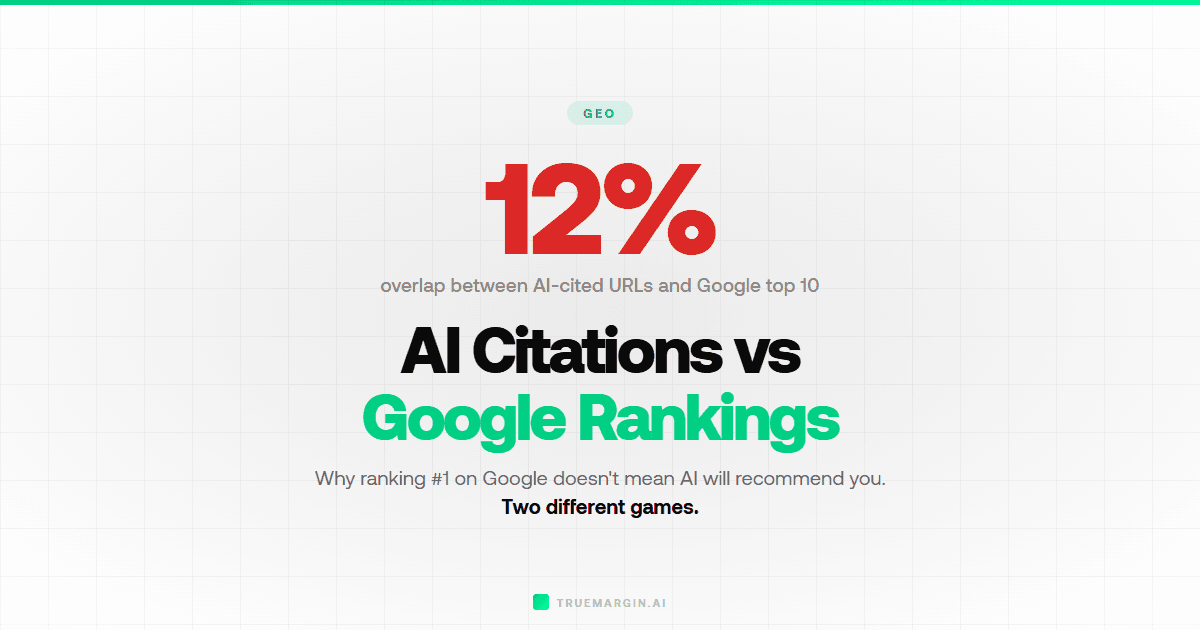
If you rank #1 on Google, AI will recommend you too, right? That's what most store owners assume. It makes intuitive sense — if Google thinks you're the best result, surely ChatGPT and Perplexity would agree. But the data tells a completely different story.
Ahrefs analyzed 15,000 prompts across ChatGPT, Gemini, and Copilot and found that only 12% of URLs cited by AI systems also rank in Google's top 10 for the same query. That means nearly nine out of ten pages AI chooses to reference are pages Google doesn't rank highly — or doesn't rank at all.
Google rankings and AI citations are driven by almost entirely different signals. The stakes are rising: ChatGPT now has 900 million weekly active users (TechCrunch), AI referral traffic grew 1,200% year-over-year (Adobe Analytics), and 64% of consumers plan to use AI for shopping in 2026 (Capital One Shopping). Understanding why rankings and citations diverge is the first step toward building visibility in both channels — instead of assuming one covers the other.
What Drives Google Rankings
Google's ranking algorithm has been refined for over two decades. While the exact formula is proprietary, the core ranking signals are well-documented through patents, official guidance, and large-scale correlation studies. They fall into a few major categories:
- Backlinks. The number and quality of external sites linking to your page remains one of the strongest ranking factors. A page with authoritative inbound links consistently outranks pages without them.
- On-page SEO. Title tags, header structure, keyword usage, internal linking, and content relevance all signal to Google what a page is about and whether it matches a searcher's intent.
- Technical SEO. Page speed, mobile responsiveness, crawlability, Core Web Vitals, and site architecture determine whether Google can properly index and serve your content.
- Content relevance. Google evaluates whether the content on a page directly answers the query. Topical depth, freshness, and E-E-A-T (Experience, Expertise, Authoritativeness, Trustworthiness) signals all factor in.
- User engagement signals. Click-through rate, dwell time, and pogo-sticking (bouncing back to results) give Google feedback on whether searchers found the page useful.
The critical point: Google ranks pages, not brands. It evaluates individual URLs against specific queries. A single product page can rank #1 for "best running shoes" while the rest of the site has minimal visibility. The unit of analysis is the page.
What Drives AI Citations
AI systems like ChatGPT, Perplexity, Gemini, and Claude operate on a fundamentally different model. They don't return a ranked list of links. They synthesize information from across the web into a conversational answer — and the brands they mention in that answer are chosen through a different set of signals:
- Brand authority and mentions. AI systems surface brands they've encountered frequently and consistently across multiple sources. The more your brand appears in forums, articles, reviews, and discussions, the more likely AI is to reference you.
- Content depth and expertise. Thin content gets ignored. AI systems draw from sources that provide comprehensive, authoritative answers to specific questions. Deep guides, original research, and expert-level analysis get cited far more than surface-level pages.
- Third-party validation. Independent editorial mentions, product roundups, expert reviews, and press coverage serve as trust signals. AI systems weight third-party validation heavily when deciding which brands to recommend.
- Presence on AI training sources. Reddit, YouTube, Wikipedia, and community forums are disproportionately represented in AI training data. Reddit alone has signed over $130M in AI training data licensing deals. Brands discussed on these platforms are more likely to appear in AI outputs.
- Structured data. Schema markup makes your information machine-readable. AI systems can extract and reference structured data more easily and accurately than unstructured content.
- Consistency. If your brand name, claims, or product information conflicts across platforms, AI systems lose confidence. Consistent information across the web increases your recommendation probability.
The critical point: AI recommends brands, not pages. It synthesizes information from the entire web — YouTube reviews, Reddit threads, editorial articles, forums — to decide which brand deserves a mention. Superlines research found that 85% of brand mentions in AI responses come from third-party pages, not the brand's own site. And 44.2% of LLM citations are drawn from the first 30% of a page's text (Superlines), meaning content structure matters enormously. The unit of analysis is the brand, not the URL.
The Data: How Little These Two Overlap
Multiple independent studies have now quantified the disconnect between Google rankings and AI citations. The findings are consistent:
- Ahrefs (15,000 prompts): Only 12% of URLs cited by ChatGPT, Gemini, and Copilot rank in Google's top 10 for the same query. Many cited URLs don't appear in the top 100 at all.
- BrightEdge (9 industries, May 2024 – Feb 2026): The overlap between AI Overview citations and top-10 organic rankings dropped from roughly 76% down to the 38–54% range after Google rolled out Gemini 3 as the default for AI Overviews in January 2026. The trend is toward less overlap, not more.
- Perplexity is the outlier: Ahrefs found that nearly 1 in 3 Perplexity citations point to pages in Google's top 10. But even at that higher rate, the majority of Perplexity citations still come from pages that don't rank well in traditional search.
The trend direction matters as much as the current numbers. As AI systems become more sophisticated in how they select sources — pulling from a wider range of content types and platforms — the overlap with Google's page-level ranking signals is shrinking, not growing.
Why the Gap Exists
The disconnect between Google rankings and AI citations isn't a bug. It's a structural consequence of how these systems work differently:
Different unit of analysis
Google evaluates individual pages. AI evaluates brands across the entire web. A page can have perfect on-page SEO and strong backlinks without the brand having any presence on Reddit, YouTube, or in editorial coverage. Google sees a great page. AI sees an unknown brand.
Different source pools
Google primarily indexes and ranks web pages. AI systems draw from a much broader pool: YouTube transcripts, Reddit threads, forum discussions, podcast transcripts, academic papers, and more. A brand that's heavily discussed on YouTube and Reddit but has a weak website will be invisible to Google and highly visible to AI — or vice versa.
Different trust signals
Google trusts backlinks as its primary authority signal. AI systems trust breadth of mention — how many independent sources reference a brand, across how many platforms, with what level of consistency. A store with thousands of backlinks from niche blogs but zero Reddit presence has strong Google signals and weak AI signals.
Query fan-out
Google matches a query to pages that target that exact query. AI systems use a process called query fan-out — they decompose a user's question into multiple sub-queries, retrieve information from different sources for each, then synthesize the results. This means AI can pull from pages that never targeted the original keyword at all. A page about "sustainable packaging materials" might get cited when someone asks "what's the most eco-friendly skincare brand?" because the AI decomposed the question and found that page relevant to one sub-query.
Are AI systems recommending your store?
Google rankings won't tell you. Our free AI Authority Checker scans the signals that actually drive AI recommendations and gives you a score in seconds.
Check Your AI Visibility Score Free →Real-World Scenarios: When Rankings and Citations Diverge
To make this concrete, here are the patterns we see repeatedly:
Scenario 1: High Google rank, invisible to AI
A Shopify store ranks on page one for its core keywords. It has strong backlinks, clean technical SEO, and well-optimized product pages. But the brand has no Reddit presence, no YouTube reviews, no editorial mentions outside of link-building campaigns. When someone asks ChatGPT "what's the best [category] brand?" — silence. The store isn't mentioned because AI has no third-party signals to draw from.
Scenario 2: No Google rankings, consistently cited by AI
A DTC brand has a basic website with minimal SEO effort. But the founder is active on Reddit, the product has dozens of YouTube reviews, and several editorial roundups mention it. The site doesn't rank for any competitive keywords. But when shoppers ask AI for recommendations, this brand comes up consistently — because AI has abundant third-party signals from the platforms it weights most heavily.
Scenario 3: Strong in both (the ideal)
A brand that invests in both traditional SEO and AI visibility. Strong backlinks and on-page optimization for Google. Active Reddit and YouTube presence, earned editorial coverage, and comprehensive structured data for AI. This brand captures traffic from both discovery channels. This is where every store should aim — but it requires treating SEO and Generative Engine Optimization (GEO) as separate disciplines with separate strategies.
What This Means for Your Strategy
The practical takeaway is straightforward: you need two strategies, not one. SEO and AI visibility are different games with different rules, different inputs, and different outcomes. Here's how to think about each:
| Dimension | Google Rankings (SEO) | AI Citations (GEO) |
|---|---|---|
| Primary signal | Backlinks + on-page optimization | Brand mentions across the web |
| Unit of analysis | Individual page | Brand / entity |
| Key platforms | Your website, linking domains | Reddit, YouTube, forums, editorial sites |
| Content type | Keyword-targeted pages | Deep, authoritative, multi-platform content |
| Trust mechanism | Link authority (PageRank) | Breadth and consistency of mentions |
| Paid influence | Indirect (PPC doesn't affect organic) | Negligible (AI rarely cites paid content) |
| Measurement | Rank tracking, Domain Authority | AI Visibility Score |
If you're already investing in SEO, keep going — organic search still drives significant traffic. But don't assume those efforts are building your AI visibility. They're almost certainly not.
The stores that will win over the next few years are the ones building presence in both channels simultaneously. For a deeper comparison of these two approaches, read our guide on GEO vs SEO for Shopify stores.
How to Start Building AI Visibility (Independent of SEO)
Since Google rankings won't build your AI presence, you need a separate playbook. Here are the highest-leverage actions, ranked by impact:
- Get discussed on Reddit authentically. Reddit has signed over $130M in AI training data deals with Google and OpenAI. Genuine brand mentions in relevant subreddit discussions flow directly into AI training pipelines. Don't spam — participate genuinely in communities where your customers hang out.
- Earn YouTube reviews and mentions. YouTube is one of the largest sources of AI citations. Product reviews, comparison videos, and "best of" roundups on YouTube carry substantial weight in AI recommendation logic.
- Pursue editorial coverage. Third-party mentions on credible publications — product roundups, expert reviews, press coverage — serve as independent validation that AI systems weight heavily.
- Publish expert-depth content. Not keyword-stuffed blog posts for Google, but genuinely deep, authoritative content that answers specific questions comprehensively. This is content that works for both GEO and SEO.
- Implement comprehensive structured data. Product schema, FAQ schema, Organization schema — structured data makes your information easier for AI systems to extract and reference accurately.
- Monitor your AI visibility separately. Use tools like our AI Authority Checker to track your AI Visibility Score independently from your Google rankings. These are separate metrics that require separate tracking.
For a comprehensive breakdown of how to measure and improve your AI presence, read our guide on AI Visibility Score for Shopify stores.
Bottom Line
Google rankings and AI citations are almost entirely independent systems. Only about 12% of URLs cited by major AI systems also rank in Google's top 10 for the same query (Ahrefs). The overlap has been shrinking, not growing, as AI systems become more sophisticated in how they select sources.
Ranking #1 on Google does not mean AI will recommend you. Having no Google rankings does not mean AI will ignore you. The signals are different, the platforms are different, and the strategies to win in each channel are different.
The stores that understand this — and build for both channels — will have a compounding advantage over competitors who assume Google covers everything. Start by checking your AI Visibility Score for free to see where you stand today.
FAQ
Do Google rankings affect AI recommendations?
Barely. Ahrefs analyzed 15,000 prompts across ChatGPT, Gemini, and Copilot and found that only 12% of the URLs those AI systems cited also ranked in Google's top 10 for the same query. Google rankings and AI citations are driven by fundamentally different signals — backlinks and technical SEO for Google, brand authority and third-party mentions for AI.
What drives AI citations if not Google rankings?
AI systems cite sources based on brand authority, content depth, third-party mentions, presence on AI training data sources like Reddit and YouTube, structured data, and editorial coverage. These signals are largely independent from the backlinks and technical SEO factors that drive Google rankings.
Can a store rank #1 on Google but be invisible to AI?
Yes. A store can dominate Google through strong backlinks and technical SEO while having almost no presence on the platforms AI systems draw from. Google rankings measure page authority. AI citations measure brand authority across the broader web. A store with great SEO but no Reddit presence, YouTube reviews, or editorial mentions will likely be invisible to AI.
Should I stop doing SEO and focus only on AI visibility?
No. SEO and AI visibility serve different discovery channels, and both drive revenue. The mistake is assuming one covers the other. You need separate strategies for each — and separate metrics to track them. Your Google rank tracker and your AI Visibility Score are measuring completely different things.
How do I check if AI systems are recommending my store?
You can use True Margin's free AI Authority Checker. It scans your brand across the signals AI systems use to generate recommendations and returns an AI Visibility Score with a detailed breakdown. No signup required.