

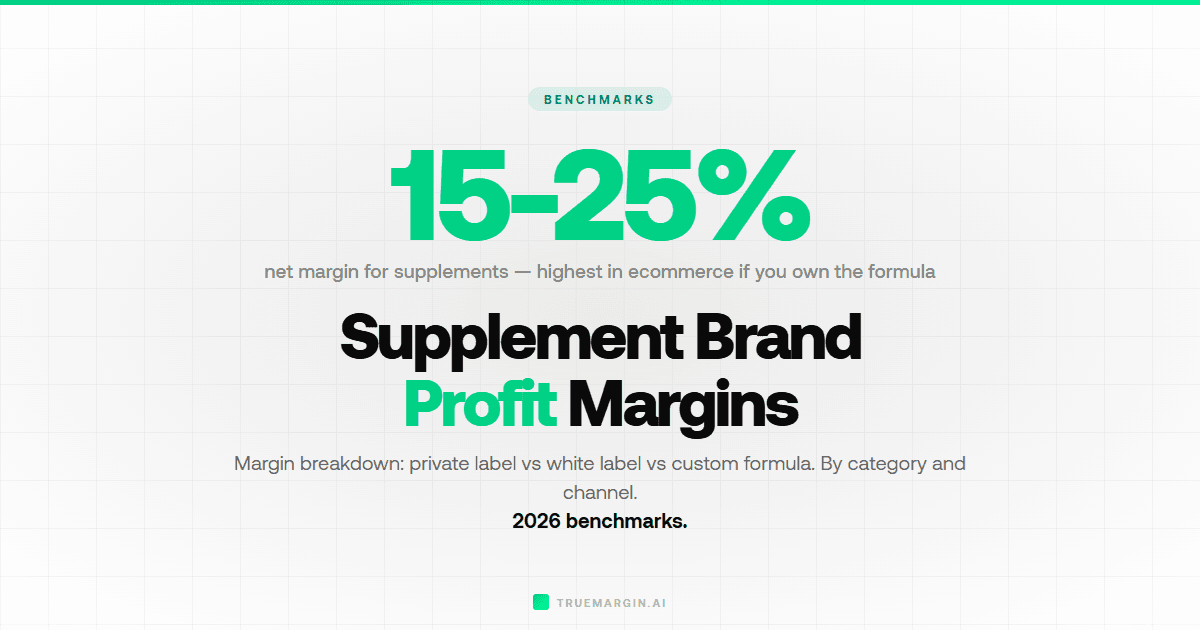
Supplement brands typically earn 50-70% gross margins and 15-25% net margins when selling direct-to-consumer — making supplements one of the highest-margin categories in all of ecommerce. Below are the 2026 benchmarks broken down by supplement type, manufacturing model, and sales channel, sourced from industry reports, manufacturer data, and DTC brand financials.
If you're new to margin fundamentals, start with our guide to calculating profit margins. This article goes deeper into the specific economics of running a supplement brand.
Average Supplement Brand Margins
The supplement industry sits in a unique position: raw materials are inexpensive, consumer willingness to pay is high, and the product is inherently consumable — meaning repeat purchases are built into the business model.
According to industry data, dietary supplement brands report gross margins between 40% and 70%, with the range depending heavily on sales channel. DTC supplement brands selling through their own Shopify stores typically land at the top of that range (60-70%), while brands selling through Amazon or retail sit lower due to platform fees and wholesale pricing.
Net profit margins — what you actually keep after COGS, marketing, shipping, platform fees, and overhead — range from 10-25% for healthy supplement brands. DTC brands with mature subscription programs can push net margins above 25% according to industry benchmarks, though most brands fall in the 15-25% range. Compare that to the ecommerce average of 5-10% net margin across all industries, and you can see why supplements are one of the most attractive verticals for new founders.
Why are margins so high? Three reasons. First, manufacturing costs per unit are low — a bottle of capsules that costs $3-5 to produce retails for $25-40. Second, supplements are lightweight and small, keeping shipping costs minimal. Third, supplements are consumable, which means a single customer acquisition can generate months or years of repeat revenue through subscriptions.
Profit Margins by Supplement Type
Not all supplements are created equal from a margin perspective. Raw ingredient costs, manufacturing complexity, and competitive pricing pressure vary significantly between categories. Here are the benchmarks based on manufacturer pricing data and typical DTC retail price points:
| Supplement Type | Typical COGS/Unit | Typical Retail Price | Est. Gross Margin | Key Factor |
|---|---|---|---|---|
| Protein Powder | $8-15 | $30-55 | 45-55% | Raw whey/plant protein is expensive; price-sensitive buyers |
| Vitamins & Minerals | $2-5 | $20-40 | 65-80% | Very low production cost; capsules/tablets cheapest to manufacture |
| Pre-Workout | $5-10 | $30-50 | 55-70% | Performance ingredients (citrulline, beta-alanine) add cost but command premium pricing |
| Collagen | $4-8 | $25-45 | 60-75% | Beauty-adjacent positioning enables premium pricing; strong subscription potential |
| Probiotics | $3-6 | $25-45 | 65-80% | Low COGS, daily-use format drives subscriptions; CFU count drives perceived value |
The pattern: the cheaper the raw ingredients and the simpler the manufacturing process, the higher the margin. Vitamins and probiotics lead because capsule production costs are minimal — often under $0.05 per capsule — and consumers evaluate these products by brand trust and label claims rather than raw ingredient cost. Protein powder sits at the bottom because whey protein concentrate and isolate are commodity ingredients with transparent wholesale pricing, and consumers are accustomed to comparison shopping on a cost-per-serving basis.
Collagen occupies an interesting middle ground. The raw collagen peptides are moderately priced, but brands that position collagen as a beauty product (rather than a fitness product) can charge premium prices and achieve margins comparable to vitamins. This is a pricing strategy decision as much as a product decision.
Manufacturing Costs Breakdown
Understanding your cost of goods sold at the line-item level is critical for supplement brands because COGS is the single largest determinant of your gross margin. Here is what goes into the per-unit cost:
- Raw ingredients: The biggest variable. Commodity ingredients like vitamin C or zinc cost pennies per dose. Specialty ingredients like branded ashwagandha (KSM-66) or patented probiotic strains can cost 10-50x more per dose. Your formula directly determines your floor cost.
- Manufacturing and encapsulation: Capsules and tablets are the cheapest at $0.20-1.50 per unit in direct production costs. Powders cost more per unit ($4-10 at small batches of 2,500 units) because of mixing, flavoring, and filling equipment time. Gummies are the most expensive format but command premium retail prices.
- Packaging and labeling: Bottles, labels, desiccants, shrink bands, and shipping boxes typically add $1-3 per unit. Custom packaging (matte bottles, embossed labels) can push this higher but also supports premium pricing.
- Testing and compliance: Third-party lab testing (identity, potency, contaminants) costs $500-2,000 per batch. NSF or GMP certifications are annual costs spread across production. These are non-negotiable for building consumer trust and are required for certain sales channels.
- Shipping to your warehouse: Freight from manufacturer to your 3PL or warehouse is typically $0.50-2.00 per unit depending on distance and volume. Domestic manufacturing reduces this cost.
At scale, total COGS for a capsule supplement product typically lands at $3-8 per unit. For powder products, $6-15 per unit. These costs decrease meaningfully with volume — a powder supplement that costs $8-10 per unit at 2,500 units can drop significantly at scale, according to manufacturer pricing data.
White Label vs Custom Formulation
Your manufacturing model has a direct impact on both short-term margins and long-term profitability. Here is how the two primary approaches compare:
| Factor | White Label | Custom Formulation |
|---|---|---|
| Upfront cost per SKU | $1,000-5,000 | $5,000-15,000+ |
| Time to market | 2-4 weeks | 3-6 months |
| Typical MOQ | 500-1,000 units | 2,500-5,000 units |
| Initial gross margin | 40-55% | 30-45% (higher upfront costs) |
| Scaled gross margin | 45-60% | 60-75% |
| Product differentiation | Low — same formula as competitors | High — unique formula you own |
White label is the faster, cheaper path to market. You pick from a manufacturer's existing formulas, add your label, and start selling. The trade-off is that your per-unit cost includes the manufacturer's margin built in, and there's limited room for long-term cost reduction because you don't own the formula. Multiple competing brands may sell the exact same product with different labels.
Custom formulation costs more upfront (R&D fees, stability testing, sometimes clinical validation) but gives you a proprietary product. As volume increases, you can negotiate directly on ingredient costs, switch suppliers, and optimize the formula — all things white label brands cannot do. Most successful supplement brands start with white label to validate demand, then transition to custom formulations for their winning products.
This is the same principle behind the good profit margin benchmarks we see across ecommerce: brands that control their supply chain earn more per unit than those who rely on intermediaries.
Know your real supplement margins — not your estimated ones.
Plug in your COGS, ad spend, shipping, and platform fees to see your true gross and net margin per product. Most supplement founders overestimate their net margin by 10-20%.
Open Profit Margin Calculator →How to Improve Supplement Brand Margins
If your margins are below the benchmarks above, here are the highest-leverage moves — ordered by impact:
- Transition from white label to custom formulation. This is the single biggest margin lever for growing brands. Owning your formula lets you negotiate ingredient costs directly, optimize dosages, and reduce per-unit costs as volume increases. Brands that make this switch typically see gross margins improve by 10-20 percentage points at scale.
- Increase average order value with bundles. A customer buying one bottle at $35 and a customer buying a 3-bottle bundle at $89 cost roughly the same to acquire. The bundled order has higher revenue at the same CAC, dramatically improving your per-order profitability. Bundles also reduce per-unit shipping costs.
- Reduce customer acquisition cost. For most supplement brands, advertising is the second-largest expense line after COGS. Better ad creatives, tighter targeting, and higher landing page conversion rates all reduce your CPA. Even a $5 reduction in CPA across thousands of orders compounds into significant margin improvement.
- Negotiate volume pricing with manufacturers. Most contract manufacturers offer 10-25% per-unit cost reductions as you scale from 2,500 to 10,000+ units per order. Lock in volume commitments for your best sellers and renegotiate quarterly as your order sizes grow.
- Add high-margin SKUs. If you sell protein powder at 45-55% gross margin, adding a vitamin or probiotic product at 65-80% margin lifts your blended margin across the catalog. Cross-selling high-margin products to existing customers is one of the cheapest ways to grow revenue.
- Optimize shipping and fulfillment. Supplement products are small and lightweight — negotiate with your 3PL based on this. Many supplement brands overpay for fulfillment because they use generic ecommerce 3PL rates rather than supplement-specific providers that handle high-volume, small-package shipping efficiently.
Subscription Impact on Margins
Supplements are one of the most naturally subscription-friendly product categories in ecommerce. Customers take supplements daily, they run out on a predictable schedule, and reordering the same product is frictionless. This creates a massive margin advantage for brands that build subscription into their business model.
Here is why subscriptions matter for your bottom line:
- Lower effective CAC. You pay to acquire a customer once. Every subsequent subscription order generates revenue at zero acquisition cost. A subscriber who stays for 6 months costs you 1/6th the CAC per order compared to a one-time buyer. Industry data shows supplement brands with strong subscription programs see meaningfully higher repurchase rates, with subscriptions being the primary driver.
- Higher lifetime value. For supplement brands, a healthy LTV-to-CAC ratio is 3:1 or higher. Subscriptions extend the customer relationship from a single transaction to months of recurring revenue. Improving retention by even 5-10% can transform overall profitability.
- Predictable inventory planning. Knowing how many subscribers you have tells you exactly how much product to order from your manufacturer. This reduces overstock waste and lets you commit to larger volume orders that lower your per-unit COGS.
- Reduced churn through engagement. Research shows that subscribers who interact with brand content between shipments churn at significantly lower rates than disengaged subscribers. Offering skip and swap flexibility also improves retention — customers who can pause or modify their subscription are significantly more likely to remain subscribers than those forced to choose between continuing and canceling.
The combination of subscription revenue and low COGS is why supplement brands consistently rank among the most profitable ecommerce categories. If your contribution margin is under 30%, focus on fixing your pricing and margins before investing in retention programs — you need enough breathing room for loyalty tiers, surprise gifts, and retention incentives to work.
DTC vs Marketplace: Where You Sell Matters
Your sales channel has as much impact on net margins as your product cost. The same supplement sold through different channels produces wildly different profitability:
- DTC (Shopify / own store): Gross margins of 60-70%. You keep the customer relationship, pay roughly 2-3% in platform and payment processing fees, and own your data for retargeting and email marketing. The trade-off is you pay for 100% of your traffic through ads and content.
- Amazon FBA: Gross margins of 35-50% after Amazon's referral fees (8-15%), FBA fees, and advertising costs. Amazon takes a significant cut, but you get access to massive built-in demand and Prime shipping. Many supplement brands use Amazon as a discovery channel and push customers to their DTC store for subscriptions.
- Retail / Wholesale: Gross margins of 25-40%. Retailers typically demand 40-50% wholesale discounts. The upside is volume and brand credibility — being in GNC or Whole Foods builds trust. The downside is you lose the customer relationship and have no subscription revenue.
DTC has grown rapidly as a share of total supplement sales over the past several years, according to industry channel data. The shift toward DTC is driven by the margin advantage: supplement brands selling direct keep significantly more revenue per sale and can build subscription relationships that multiply customer lifetime value.
Frequently Asked Questions
What is a good profit margin for a supplement brand?
A good gross margin for a supplement brand is 50-70%, with DTC brands on the higher end. Net margins of 15-25% are considered healthy. If your gross margin is below 50% or your net margin is below 10%, your COGS, ad spend, or pricing likely needs adjustment. Run your numbers through our profit margin calculator to identify where the gap is.
Which supplement type has the highest profit margin?
Vitamins and probiotics typically lead with gross margins of 65-80%. Capsule and tablet manufacturing is very inexpensive — often under $0.05 per capsule — and consumers evaluate these products by brand trust rather than raw ingredient cost. Protein powders have the lowest margins at 45-55% because whey and plant protein are commodity ingredients that consumers comparison-shop aggressively.
Is white label or custom formulation more profitable?
White label is more profitable in the short term due to lower upfront costs and faster time to market. Custom formulations become more profitable at scale because you own the formula and can negotiate ingredient costs directly. Most successful supplement brands start white label and transition to custom formulations once they find winning products and have sufficient volume to justify the R&D investment.
How do subscriptions impact supplement profit margins?
Subscriptions improve net margins significantly by reducing effective CAC on repeat orders and increasing customer lifetime value. A subscriber who stays for 6 months has 1/6th the acquisition cost per order compared to a one-time buyer. Industry data shows that engaged subscribers churn at significantly lower rates, and supplement brands with mature subscription programs report the highest net margins in the category.
How much does it cost to manufacture supplements?
Manufacturing costs depend on format and volume. Capsules and tablets cost $0.20-1.50 per unit in direct production. Powder supplements cost $4-10 per unit at small batches (2,500 units), dropping to roughly $2-5 at scale. Most manufacturers require minimum order quantities of 2,500-5,000 units per SKU, with first production runs typically costing $5,000-10,000. See our COGS calculation guide for a full breakdown of how to track these costs.