

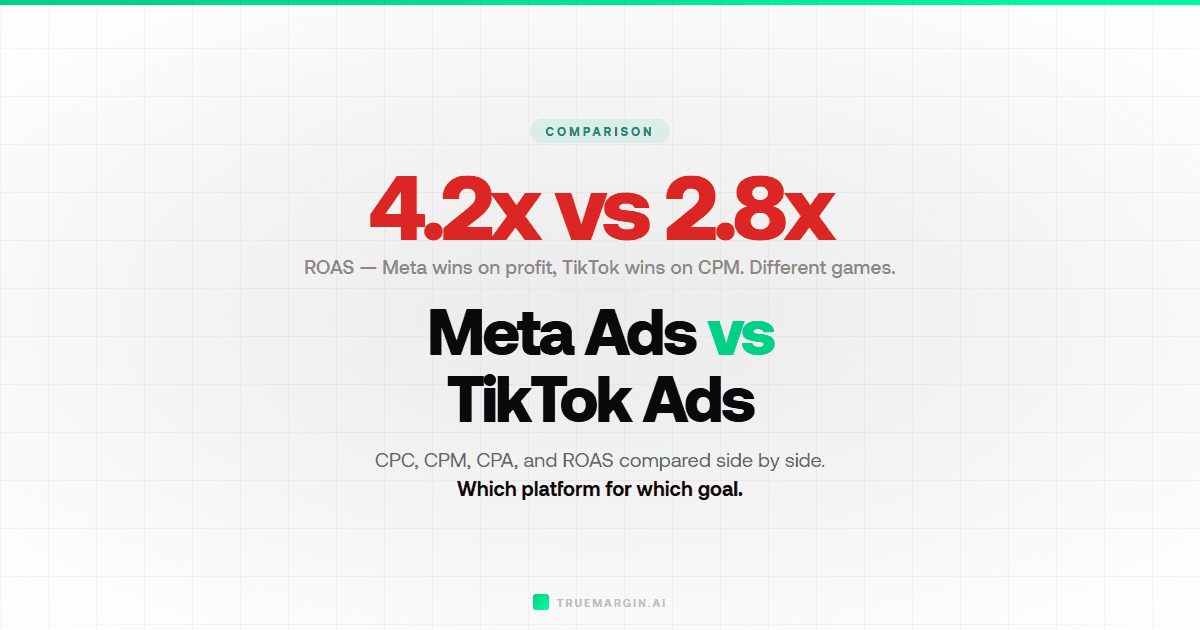
TikTok is cheaper per click and per impression. Meta converts better and delivers higher ROAS on average. That is the 1-sentence answer. But “on average” hides a lot of nuance — TikTok fashion and beauty campaigns can hit 6.1x ROAS while Meta ecommerce sits at 3.8-5.2x depending on category. The right platform depends on where your customers are in the funnel, what you sell, and which tools you use to measure performance across both.
Below is every cost and performance metric that matters for 2026, pulled from current benchmark data from sources like Triple Whale, Varos, and WordStream. We also cover the real tools practitioners use to spy on competitors, attribute conversions, and optimize creative — with actual pricing. Use this to decide where your next dollar goes, or how to split it between both.
CPM Comparison: Meta vs TikTok
Cost per thousand impressions is where the gap has historically been widest — but it is narrowing. TikTok CPMs have been rising as more advertisers pile onto the platform, while Meta's median CPM sat at $13.48 across all industries in 2025 according to WordStream benchmark data.
| Metric | Meta (Facebook/Instagram) | TikTok |
|---|---|---|
| Ecommerce CPM | $6.96-$12.46 | $3.21-$9.16 |
| U.S. Average CPM | $13.48 median | $4.80-$9.16 |
| Q4 CPM Spike | 25-66% increase | Moderate increase |
TikTok CPMs still run lower than Meta, but the gap is shrinking. TikTok is pricing itself closer to Meta as advertiser demand grows, which means it is becoming less of a “budget alternative” and more of a platform that requires creative excellence to maintain cost efficiency. The Q4 gap remains wide — Meta CPMs can surge 25-66% during holiday demand while TikTok increases are less severe due to more available inventory relative to advertiser demand.
You can track these CPM trends in real time with Varos (free tier available at varos.com), which benchmarks your Meta and TikTok costs against 6,000+ ecommerce brands with $6B+ in tracked ad spend. Their data updates every 4 hours so you are never guessing whether your CPMs are above or below the curve.
CPC Comparison: Meta vs TikTok
Cost per click tells you what it costs to get someone to your site. TikTok wins here too, but the margin is narrower than CPM — and Meta's CPC has actually been trending down.
| Metric | Meta | TikTok |
|---|---|---|
| Global Average CPC | $1.07-$1.11 | $0.30-$1.50 |
| U.S. Average CPC | $1.11-$1.32 (peaks Nov) | $0.20-$2.00 |
| Ecommerce CPC | ~$1.07 | $0.25-$1.00 |
Meta's ecommerce CPC averaged about $1.07 globally in 2025 — roughly 5% below the all-industry average — according to WordStream data spanning January 2025 through January 2026. That is lower than older estimates of $1.50-$3.00 that still circulate. Meta CPC peaked at $1.32 in November during holiday demand, then reset to $0.85 by January 2026.
TikTok still undercuts Meta on CPC, with most ecommerce advertisers paying $0.25-$1.00. For brands spending $5,000 per month, the difference is meaningful — at $0.50 CPC on TikTok you get 10,000 clicks versus roughly 4,700 at $1.07 on Meta. The question is what happens after the click.
ROAS Comparison: Meta vs TikTok
This is where Meta fights back — and wins for most advertisers. ROAS is what actually determines profitability, and Meta's conversion infrastructure is still ahead. According to 2026 benchmark data, Meta delivers an average ROAS of 4.2x across its platforms compared to TikTok's 2.8x.
| Metric | Meta | TikTok |
|---|---|---|
| Average ROAS | 3.8-5.2x | 2.8x average |
| Consumer Goods ROAS | 3.8-4.2x | 4.2x |
| Fashion/Beauty ROAS | 3.5-5.2x | Up to 6.1x |
| Advantage+ vs Manual | 32% higher ROAS (Advantage+) | N/A |
Meta's overall ROAS (3.8-5.2x) typically beats TikTok's (2.8x), but the gap varies by vertical. Consumer goods brands actually report comparable ROAS on TikTok (4.2x), and fashion and beauty brands on TikTok often hit 6.1x or higher. Meta's advantage comes from years of pixel data, mature lookalike audiences, and conversion-optimized delivery. If you are running Facebook Ads focused on purchases, Meta's machine learning still knows exactly who is likely to buy.
One critical nuance: TikTok has a lower delta between CPA and net-new CPA (about 10%) compared to Meta's 38%. That means TikTok is generating more genuinely new customers while Meta spends more budget re-acquiring existing ones. If you are measuring blended ROAS without proper attribution, Meta's numbers look better than they are because they include retargeting existing customers.
Meta Advantage+ Shopping Campaigns deserve special mention. According to Meta, brands using Advantage+ see an average 12% lower CPA and 32% higher ROAS compared to manual campaigns. But this comes with a caveat: Advantage+ delivers superior results for accounts spending above $10K/month, while accounts under $5K/month often get better results from manual campaigns where you control targeting directly.
Meta CPA by Category
Cost per acquisition varies wildly by what you sell. These Meta benchmarks from Triple Whale and WordStream data help set realistic expectations:
| Category | Average CPA (Meta) |
|---|---|
| Lifestyle & Boutique | $29.99 |
| Baby Products | $30.04 |
| Books & Music | $30.25 |
| All Industries Median | $38.17 |
| Travel Accessories | $48.37 |
| Electronics | $49.48 |
If your average order value is $80, a $29.99 CPA on lifestyle products leaves solid room for margin. A $49.48 CPA on electronics with a $75 AOV does not. Knowing your category CPA against your margins is how you decide if a platform is viable — not just whether it is “cheap.” True Margin's free ad budget calculator helps you model this before you spend.
The Tools Practitioners Actually Use
The difference between guessing and knowing is tooling. Here are the real tools ecommerce media buyers use to run Meta and TikTok ads, with actual pricing.
Attribution and Analytics
Platform-reported ROAS is unreliable because both Meta and TikTok over-count conversions. Third-party attribution tools solve this by showing you what actually drove the sale.
- Triple Whale (from $129/month) — the go-to for Shopify brands under $20M revenue. Connects Meta, TikTok, Google, and email into a single dashboard with first-click, last-click, and linear attribution. The Growth plan runs $129-$3,599/month scaled to your revenue.
- Northbeam (from $1,500/month) — built for brands doing $40M+ in revenue. Its attribution model ensures total attributed conversions never exceed your actual order count, which prevents the double-counting problem you get from adding up Meta and TikTok dashboard numbers. Scales with data volume.
- Varos (free tier available) — real-time benchmarking across 6,000+ companies. See how your Meta and TikTok CPMs, CPCs, and ROAS stack up against brands in your vertical and spend level. Data updates every 4 hours.
Ad Spy and Competitive Research
Before you spend a dollar on creative, see what is already working for competitors. These tools let you search competitor ad libraries across both platforms.
- TikTok Creative Center (free) — TikTok's own tool and the best free starting point. Includes a Top Ads dashboard showing best-performing ads by vertical and region, keyword insights for ad copy, an AI script generator, and a royalty-free music library. Available to anyone with a TikTok Business account.
- Foreplay ($49-$99/month) — saves ads from Meta, TikTok, and LinkedIn into a searchable swipe file. The $49 Inspiration plan gives access to 500K+ ads. The $99 Workflow plan adds AI-powered search, filtering, and an AI brief builder that turns saved ads into creative briefs and storyboards. 7-day free trial.
- Minea (from $49/month) — tracks 200M+ ads across Facebook, TikTok, and Pinterest, updated daily. Good for dropshippers and DTC brands looking for product-level winning ads. 200 free credits to start.
- PiPiADS ($77-$277/month) — TikTok-focused ad spy with the deepest TikTok ad database. The $77 Starter plan covers basic spy features. The $277 Professional plan adds unlimited searches and advanced analytics. If you are running TikTok ads seriously, this is the specialized tool.
- AdSpy ($149/month) — the largest Meta-only ad database with 155M+ ads across 88 languages and 220+ countries. No TikTok coverage, but the deepest Facebook and Instagram library available. No free trial.
Creative Reporting and Optimization
Once ads are running, you need to know which creatives are winning and why — not just which campaigns hit ROAS targets.
- Motion (from $250/month) — creative analytics for Meta, TikTok, YouTube, and LinkedIn. Automatically groups creatives and surfaces winning patterns with AI tagging. Best for teams launching 10+ creatives per month and spending $25K+ on Meta. Shows a weekly leaderboard with week-over-week performance trends.
- Madgicx (from $44/month) — AI-powered budget optimization for Meta. The Autonomous Budget Optimizer redistributes spend across campaigns in real time based on performance. Best for ecommerce brands scaling from $5K to $100K+ monthly ad spend.
- Kalodata ($45.90-$99.90/month) — TikTok Shop analytics with product-level sales tracking, creator discovery, and market intelligence. Data refreshes every 15 minutes. The Professional plan at $99.90/month adds historical data and AI features. 7-day free trial, no card required.
Where Each Platform Wins
The data tells a clear story about strengths and weaknesses. Neither platform is universally better — they solve different problems.
- TikTok wins on new customer acquisition. Lower CPMs, lower CPCs, and a 10% delta between CPA and net-new CPA (versus Meta's 38%) mean TikTok generates more genuinely new customers. The algorithm serves content based on viewer behavior signals — watch time, engagement velocity, interaction depth — regardless of whether they follow you.
- Meta wins on retargeting and conversion. The Facebook Pixel and Conversions API give Meta a massive edge on bringing back visitors who already showed interest. Advantage+ Shopping Campaigns deliver 32% higher ROAS than manual campaigns for accounts spending $10K+/month.
- TikTok wins on creative testing. Lower costs mean you can test 10 creatives on TikTok for the price of 3 on Meta. Use TikTok Creative Center (free) to research trending formats, then use Foreplay ($49/month) to save winning competitor ads as a swipe file. Find angles cheaply, then port winners to Meta.
- Meta wins on scaling proven campaigns. Once you have a winner, Advantage+ campaigns can scale spend while maintaining ROAS stability. Tools like Madgicx ($44/month) automate budget redistribution across ad sets so scaling does not require constant manual babysitting.
The 2-Platform Strategy That Works
Most brands making over $50,000 per month in revenue should run both platforms. Here is how practitioners actually split the funnel:
TikTok handles the top of funnel. Spend 30-40% of your ad budget on TikTok prospecting. Use native-feeling creative — TikTok users scroll past anything that looks like a polished studio ad. Research what is working in your vertical using TikTok Creative Center's Top Ads dashboard (free), then use Spark Ads with creator authorization codes to run organic-looking content. Your goal is awareness and cheap traffic at $0.50-$1.00 CPC.
Meta handles the bottom of funnel. Spend 60-70% of your budget on Meta, with the majority going to retargeting. Hit TikTok visitors with Meta retargeting ads within 3-7 days using Advantage+ Shopping Campaigns. This is where Meta's conversion optimization earns its premium — you are paying higher CPMs but showing ads to people who already watched your TikTok content and visited your site. For accounts above $10K/month, Advantage+ typically delivers 32% higher ROAS than manual campaign structures.
Measure across both with third-party attribution. Do not just add up in-platform ROAS numbers — both Meta and TikTok will over-claim conversions. Use Triple Whale ($129/month for Shopify brands) or Northbeam ($1,500/month for larger operations) to see which platform actually drove each sale. Without this, you are optimizing with bad data.
This approach works because it plays to each platform's strength instead of forcing one to do everything. You get TikTok's cheap reach and new customer acquisition plus Meta's conversion power and retargeting precision. The combined ROAS across both platforms typically beats running either one alone.
If you are comparing this to Google, our Facebook Ads vs Google Ads breakdown covers that matchup separately.
Not sure how to split your budget between Meta and TikTok?
Use True Margin's free ad budget calculator to model your spend across platforms and find the split that protects your margins.
Open Ad Budget Calculator →Frequently Asked Questions
Are TikTok Ads cheaper than Meta Ads?
Yes, on a per-impression and per-click basis. TikTok CPMs average $3.21-$9.16 compared to Meta's $6.96-$12.46 for ecommerce. TikTok CPC runs $0.25-$1.00 for most ecommerce advertisers while Meta averages about $1.07 globally. However, the CPM gap is narrowing as more advertisers move to TikTok. Meta still delivers higher conversion rates and stronger ROAS on retargeting campaigns.
Which platform has better ROAS for ecommerce?
Meta delivers a higher overall average ROAS of 3.8-5.2x compared to TikTok's 2.8x average. But this varies by category — TikTok fashion and beauty campaigns can reach 6.1x ROAS, and consumer goods brands report 4.2x on TikTok. Meta's advantage comes from mature retargeting and Advantage+ Shopping Campaigns, which deliver 32% higher ROAS than manual campaigns. Use third-party attribution tools like Triple Whale (from $129/month) or Northbeam (from $1,500/month) to get accurate cross-platform ROAS instead of trusting in-platform numbers.
Should I run ads on both Meta and TikTok?
For most ecommerce brands doing $50K+ per month, yes. The strongest strategy uses TikTok for low-cost top-of-funnel acquisition (it has a 10% delta between CPA and net-new CPA, meaning most customers are genuinely new) and Meta for retargeting and conversion campaigns (where Advantage+ excels for accounts spending $10K+/month). Use Varos (free tier) to benchmark your costs against 6,000+ brands and confirm you are getting competitive rates on both platforms.
Why do Meta CPMs spike in Q4?
Meta CPMs can surge 25-66% during Q4 because of holiday advertising demand. WordStream data shows Meta CPC peaked at $1.32 in November 2025 before resetting to $0.85 by January 2026. Every brand bids harder for the same audience pool during Black Friday, Cyber Monday, and the holiday gift season. TikTok also sees Q4 increases but they are less severe because the platform has more available inventory relative to advertiser demand. Q4 represents over 30% of total annual ecommerce revenue, so the higher costs are typically still worth the investment.
What free tools should I use before spending on ads?
Start with TikTok Creative Center (completely free) to research top-performing ads in your vertical, get AI-generated ad scripts, and find trending formats. Use the Meta Ad Library (free) to see every active ad from any competitor. Varos (free tier) lets you benchmark your costs against thousands of ecommerce brands. Once you are spending enough to justify it, Foreplay ($49/month) and Motion ($250/month) help with creative workflow and performance analysis respectively.