

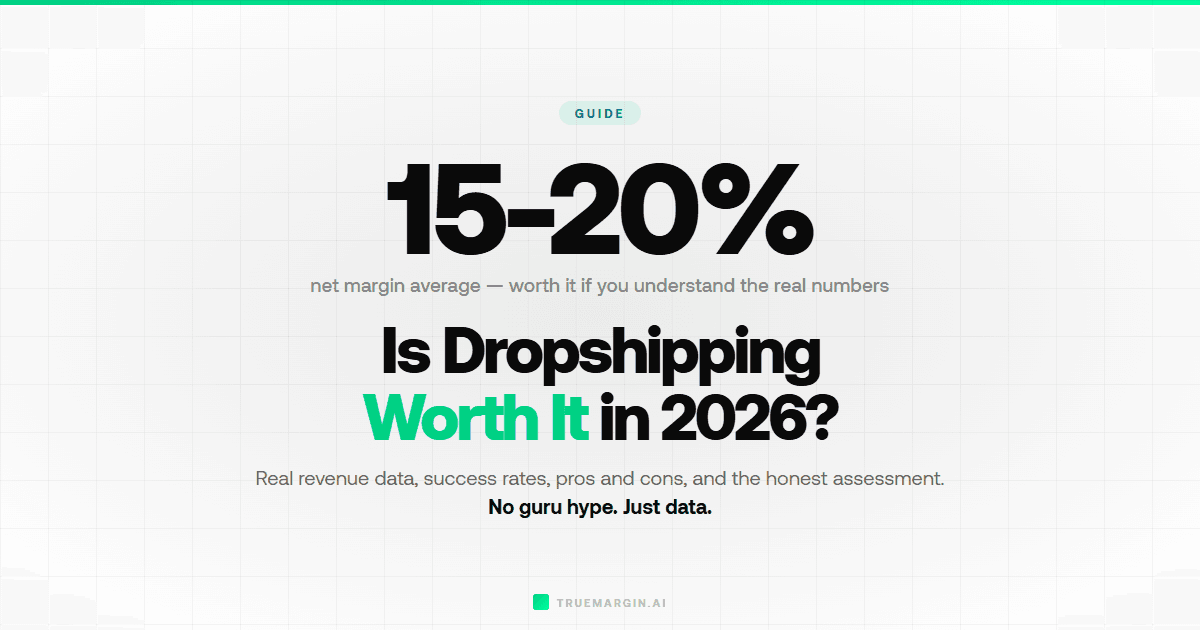
Yes, dropshipping is still worth it in 2026 — but only if you treat it as a real business, not a shortcut to passive income. The model has changed dramatically since its peak hype years. Tariffs have gutted the cheap-Chinese-goods playbook, ad costs keep climbing, and the “just run TikTok ads to a generic store” era is over. Yet the global dropshipping market continues to grow, and sellers who adapt are still building profitable businesses.
This guide covers what actually changed, what the numbers say, who should start dropshipping today, and who should pick a different model. If you already have a store and want to check whether your margins are sustainable, run your numbers through our free dropshipping profit calculator before reading further — the rest of this article will make more sense when you know your actual per-order profit.
The Short Answer
Dropshipping is worth it in 2026 if you meet three conditions: you choose a focused niche instead of a general store, you understand your real profit margins (not just gross markup), and you have enough capital to test products properly before expecting returns. If any of those three are missing, you are more likely to join the estimated 80-90% of dropshippers who fail within the first year.
The business model itself is not dead. According to multiple market research firms, the global dropshipping market was valued at over $300 billion in 2025 and is projected to grow at a compound annual growth rate above 20% through 2030. But the profile of who succeeds has shifted. The winners in 2026 are brand builders, not arbitrage chasers.
What Changed in 2025-2026
Two structural shifts reshaped dropshipping over the past 18 months, and both hit the traditional model hard.
1. The De Minimis Exemption Is Gone
The U.S. de minimis exemption used to let shipments valued under $800 enter the country without customs duties. This was the economic backbone of direct-from-China dropshipping — a $6 product could reach a U.S. customer with zero import fees. In mid-2025, the U.S. eliminated this exemption for Chinese and Hong Kong imports. Shipments now face either a 120% ad valorem duty or a flat fee of $200 per item, whichever is higher. In February 2026, a 15% global import surcharge was added under Section 122 of the Trade Act of 1974.
For dropshippers who relied on sub-$50 products shipped directly from Chinese suppliers, the math often no longer works. Brokerage fees, bond premiums, and filing fees can exceed the value of the product itself. This does not mean dropshipping is dead — it means the China-direct model needs rethinking.
2. Ad Costs Keep Rising
Facebook, Instagram, and TikTok CPMs have increased year over year. Platforms like Instagram and TikTok are saturated with dropshipping ads, driving up cost-per-click rates for everyone in the space. The days of $5 CPAs on Facebook are gone for most product categories. This makes product selection and pricing strategy more important than ever — you need enough margin per order to absorb higher ad costs and still net a profit.
The Numbers: Market Size and Success Rates
Market Size
The dropshipping market remains large and growing. Multiple market research firms estimate the global dropshipping market at over $300 billion in 2025, with projections showing continued growth at a compound annual growth rate above 20% through the end of the decade. Some estimates project the market will surpass $1 trillion by 2030. A significant share of online retailers now use dropshipping as their primary fulfillment method.
However, market size is not the same as individual profitability. A growing market means more opportunity, but it also means more competition.
Success Rates
Industry estimates consistently put the dropshipping success rate at 10-20% within the first year. That means 80-90% of stores fail. Some sources cite even higher failure rates in the first 12 months. The survivors tend to share common traits: they research their niche before launching, they track unit economics from day one, and they have realistic timelines — expecting 3-6 months of testing before consistent profitability.
Successful dropshippers report net profit margins of 15-20%, with high performers reaching closer to 30%. Beginners and poorly optimized stores often fall below 10%. For context, that means for every $10,000 in revenue, a typical profitable dropshipper takes home $1,500 to $2,000 in actual profit after all costs.
5 Pros of Dropshipping in 2026
1. Low Startup Cost
You can launch a store for a few hundred dollars — a Shopify subscription, a domain, and a small ad budget. Compare that to private label, which often requires $5,000-$15,000 in upfront inventory. Dropshipping remains one of the lowest-barrier entry points into ecommerce. For a detailed breakdown, see our guide on how much it costs to start dropshipping.
2. No Inventory Risk
You only pay for products after a customer orders. No warehousing, no unsold stock, no liquidation headaches. If a product does not sell, you simply stop listing it. This makes testing new products significantly cheaper than any inventory-based model.
3. Location Independence
The entire business runs online. You do not handle, ship, or store anything. This makes dropshipping accessible to people who cannot commit to a physical location or who want to run a business while traveling or working another job.
4. Wide Product Selection
You can list hundreds of products across multiple suppliers without buying a single unit upfront. This lets you test market demand in real time and pivot quickly when trends shift — a major advantage in a market that moves as fast as ecommerce does in 2026.
5. Scalability Without Warehousing
Scaling a traditional ecommerce business means bigger warehouses, more staff, and more capital tied up in inventory. Scaling a dropshipping business means increasing ad spend and onboarding additional suppliers. The operational ceiling is much higher relative to the capital required.
5 Cons of Dropshipping in 2026
1. Thin Margins Under Pressure
Average dropshipping net profit margins sit at 15-20% for experienced sellers and often below 10% for beginners. Tariffs, rising ad costs, and platform fees all compress margins further. A $2 increase in CPA can flip a profitable campaign into a money-losing one. This is why tracking your true per-order profit — not just topline revenue — is non-negotiable.
2. Supplier Dependency
You do not control inventory, shipping speed, or product quality. When a supplier raises prices, runs out of stock, or ships late, you absorb the customer complaint. Tariff-driven cost increases in 2025-2026 have amplified this risk — suppliers pass their higher costs to you, and you either eat the margin loss or raise prices and risk losing conversions.
3. Intense Competition
Low barriers to entry mean thousands of stores sell the same products from the same suppliers. Customers price-compare easily, and the seller with the lowest price (or best creative) wins. Building a brand and offering genuine differentiation — curated product selection, fast shipping, great customer service — is the only sustainable defense.
4. Limited Control Over Customer Experience
Shipping times, packaging quality, and product consistency are in your supplier's hands. Long shipping times (especially from overseas suppliers) remain one of the biggest sources of negative reviews and chargebacks. Customers in 2026 expect Amazon-speed delivery, and most dropshipping operations cannot match that.
5. Tariff Exposure
The 2025-2026 tariff changes hit dropshipping harder than most ecommerce models because the business depends on low-cost imported goods with thin margins. Sellers sourcing from China face duties that can exceed the product's value. Adapting means finding domestic suppliers, sourcing from non-tariffed countries, or switching to models like print-on-demand that are less exposed.
Are your margins actually sustainable?
Plug in your product cost, ad spend, shipping, platform fees, and return rate — see your true net profit per order and whether your store is viable after tariffs.
Open Dropshipping Profit Calculator →Who Should Dropship in 2026
Dropshipping still makes sense for a specific profile of entrepreneur. You are a good fit if:
- You are testing the ecommerce waters. You want to learn online selling — ad buying, conversion optimization, supplier management — without risking thousands on inventory. Dropshipping is the lowest-cost classroom for ecommerce fundamentals.
- You have limited capital. If you cannot afford $5,000-$15,000 for private label inventory, dropshipping lets you start with $500-$2,000 and learn by doing.
- You are willing to build a brand. The generic-store model is dying. If you are prepared to pick a niche, build a real brand identity, and invest in customer experience, the model rewards you.
- You have a marketing skill set. Dropshipping is fundamentally a marketing business. If you are strong at paid ads, content creation, or influencer partnerships, you can acquire customers profitably where others cannot.
- You want to validate before committing. Testing product-market fit with dropshipping before moving to private label or wholesale is a proven playbook. Many successful DTC brands started as dropshipping stores.
Who Should NOT Dropship in 2026
Dropshipping is not for everyone, and starting with the wrong expectations is the fastest way to lose money:
- You expect passive income. Dropshipping requires active work — finding products, managing suppliers, running ads, handling customer service. It is not a set-and-forget business.
- You have zero ad budget for testing. Without at least $500-$1,000 for ad testing, you cannot validate products or optimize campaigns. Running out of budget before finding a winner is the most common failure mode.
- You want premium margins from day one. If you need 30%+ net margins immediately, you are better served by private label or wholesale, where you control costs and branding.
- You are not willing to deal with customer complaints. Supplier mistakes become your problem. Late shipments, wrong items, and quality issues land on your customer service desk, not the supplier's.
- You only plan to resell cheap Chinese goods to the U.S. The tariff landscape in 2026 makes this model extremely difficult. If your entire business plan is “buy for $3 from AliExpress, sell for $25 on a Shopify store,” the duties alone may make it unprofitable.
Alternatives to Consider
If after reading this you think dropshipping is not the right fit, here are four models worth evaluating:
1. Print-on-Demand
Similar to dropshipping (no inventory), but you sell custom-designed products — t-shirts, mugs, posters, phone cases. Per-unit costs are higher than standard dropshipping, but you own the design, which creates differentiation and eliminates direct competition. Tariff exposure is lower because many POD suppliers operate domestically.
2. Private Label
Buy products in bulk from a manufacturer, brand them as your own, and sell at higher margins. Startup costs are significantly higher ($5,000-$15,000+), but net margins of 25-40% are realistic because you control pricing and branding. Many successful dropshippers graduate to private label once they find a winning product. Our dropshipping vs. private label comparison breaks down when to make the switch.
3. Wholesale / Reselling
Purchase established brand products at wholesale prices and resell on your own store, Amazon, or other marketplaces. Requires upfront inventory investment but gives you faster shipping (you hold the stock) and the credibility of selling known brands.
4. Affiliate Marketing
Earn commissions by referring customers to other companies' products. Zero fulfillment, zero customer service, zero inventory. The tradeoff is that margins are entirely controlled by the merchant (typically 5-30% commission), and you build someone else's brand instead of your own.
How to Decide: A Simple Framework
Ask yourself three questions:
- Do I have less than $2,000 to invest? If yes, dropshipping or affiliate marketing are your only realistic options.
- Am I willing to spend 3-6 months testing before expecting profit? If yes, dropshipping rewards patience. If no, you will likely quit before finding a winner.
- Do I want to build a brand I can eventually sell? If yes, start with dropshipping to validate, then transition to private label. If no, affiliate marketing may be a better fit.
Whatever you choose, run the numbers before you launch. Most failures come from not understanding unit economics — not from the business model being broken. The True Margin profit calculator shows you exactly what you will keep per order after every cost is accounted for.
Frequently Asked Questions
Is dropshipping still profitable in 2026?
Yes. Successful dropshippers report net profit margins of 15-20%, with high performers reaching 30%. However, beginners typically net under 10%, and an estimated 80-90% of stores fail within the first year. Profitability depends on niche selection, ad efficiency, and whether you account for all costs — not just product cost. Use our dropshipping profit margin guide to understand the full cost picture.
What is the dropshipping success rate?
Industry estimates put the first-year success rate at 10-20%. The main reasons for failure are underfunding (running out of ad budget before finding a winner), poor product selection, and not tracking unit economics. Success rates improve significantly for sellers who research their niche, build supplier relationships, and set realistic timelines of 3-6 months before expecting consistent profit.
How much money do I need to start dropshipping?
A bare minimum of $200-$500 covers a Shopify subscription, domain, and initial ad spend. However, most experts recommend $1,000-$2,000 to properly test products and run ads long enough to gather meaningful data. Underfunded stores fail at higher rates because they cannot test enough products or optimize campaigns before the budget runs out. See our full breakdown of how much it costs to start dropshipping.
How have tariffs affected dropshipping?
The elimination of the U.S. de minimis exemption in 2025 ended duty-free entry for low-value imports. Shipments from China now face duties of 120% ad valorem or $200 per item (whichever is higher), plus a 15% global import surcharge added in February 2026. This has made the China-direct model significantly more expensive. Sellers are adapting by sourcing from domestic suppliers, finding suppliers in non-tariffed countries, raising prices, or transitioning to private label and print-on-demand models.
What are the best alternatives to dropshipping?
The four main alternatives are print-on-demand (no inventory, custom products, lower tariff exposure), private label (higher margins but requires $5,000-$15,000+ upfront), wholesale (you hold inventory of established brands), and affiliate marketing (zero fulfillment, commission-based income). The right choice depends on your budget, risk tolerance, and whether you want to build a sellable brand.