

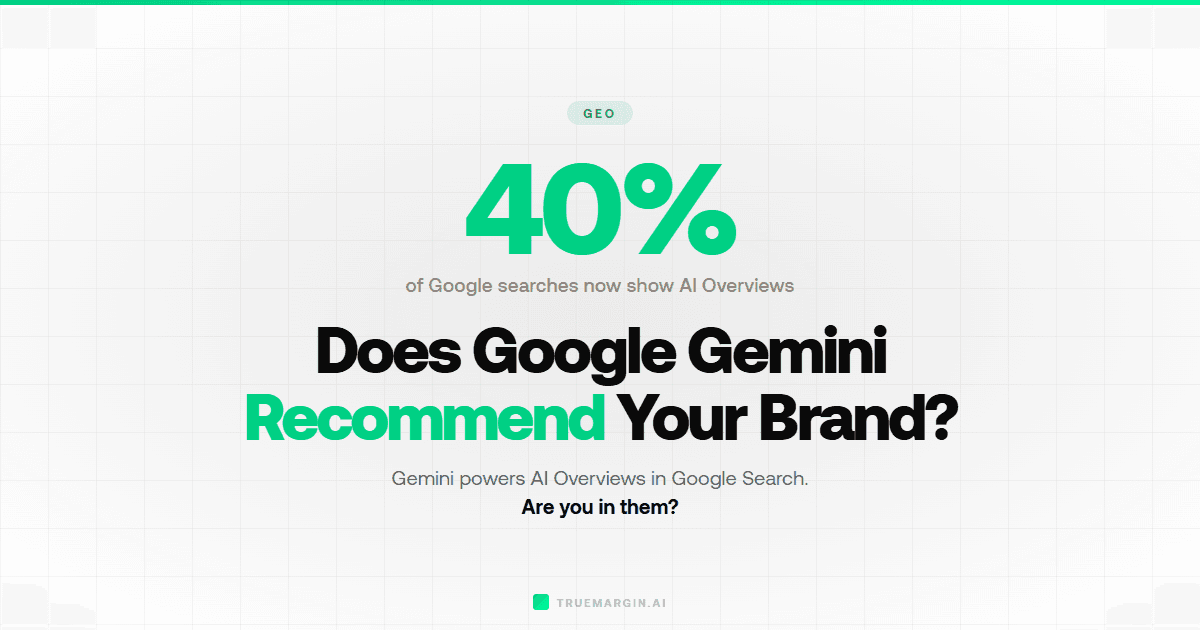
Google Gemini is the AI platform that should worry you the most. Not because it's better than ChatGPT at recommendations (debatable), but because it's integrated directly into Google Search. And here's the thing: Gemini has a 21.4% brand mention rate, nearly three times higher than ChatGPT's 7.9%. That means when someone asks Gemini about your category, there's a much higher chance brands get named specifically.
When someone Googles "best CRM for small business," there's a good chance an AI Overview appears at the top of the results. That overview is powered by Gemini. It recommends specific brands. And it sits above every organic result and every paid ad on the page.
If you're not in that AI Overview, you just lost the top spot to a robot. Research from Seer Interactive found that brands cited in AI Overviews earn 35% more organic clicks than those that aren't. Being in the overview doesn't just mean AI visibility; it boosts your traditional search traffic too.
How Gemini Differs From ChatGPT and Perplexity
Gemini has two modes of recommending brands, and most people only think about one of them.
Mode 1: Standalone Gemini. The chatbot at gemini.google.com works similarly to ChatGPT. You ask it questions, it generates answers. It pulls from training data and can search the web when needed.
Mode 2: AI Overviews in Google Search. This is the bigger deal. When Google decides a search query would benefit from an AI-generated summary, Gemini creates one and places it above the traditional search results. This happens on product queries, comparison queries, and "best of" queries.
Mode 2 is where the real traffic impact lives. Your customers are already searching Google. Now an AI summary is intercepting them before they ever click a blue link. That changes everything.
| Feature | Gemini (AI Overviews) | ChatGPT | Perplexity |
|---|---|---|---|
| Data source | Google Search index + Knowledge Graph | Training data (+ optional browsing) | Real-time web search |
| Where users see it | Top of Google search results | ChatGPT app/website | Perplexity app/website |
| Shows sources | Yes, linked cards alongside the overview | Sometimes (browsing mode) | Always, numbered citations |
| SEO ranking matters | Directly (ranking = visibility) | Indirectly | Directly |
| Google Business Profile matters | Yes, heavily | No | Minimally |
| Audience reach | Billions of Google users | Hundreds of millions | Tens of millions |
Gemini reaches more people than any other AI platform because it's embedded in Google Search. That alone makes it the highest priority for most brands. Consider the scale: ChatGPT alone has 900 million weekly active users, and Gemini rides on top of Google's even larger search audience.
How to Test Your Gemini Visibility
Testing Gemini requires checking two different surfaces: the standalone chatbot and AI Overviews in search.
Testing AI Overviews
Open Google in an incognito window (to avoid personalization bias). Search for the same types of queries your customers would use.
- "Best [your category] 2026"
- "What [product type] should I use for [use case]?"
- "[Your category] comparison"
- "[Your brand] vs [competitor]"
Look for the AI Overview box at the top of results. If one appears, check whether your brand is mentioned. Also note which sources are linked in the sidebar cards, because those are the pages Gemini drew from.
Not every query triggers an AI Overview. Product and recommendation queries are more likely to get one than informational queries. Try multiple variations.
Testing Standalone Gemini
Go to gemini.google.com and ask the same category and comparison questions. The standalone version often gives more detailed responses than AI Overviews (which are compressed to fit into search results).
I'd recommend testing both, because the responses can differ. The standalone version has more room to elaborate and might mention brands that get cut from the shorter AI Overview format.
Check your brand visibility across Gemini, ChatGPT, Perplexity, and more in one scan.
True Margin's free AI visibility scanner shows your score across every major AI platform. See which queries mention you and which competitors appear instead.
Scan Your Brand Free →What Signals Gemini Uses (That ChatGPT Doesn't)
Gemini has access to Google's entire infrastructure. That means signals that don't matter for ChatGPT can matter a lot for Gemini.
Google Search Rankings
This is the biggest one. AI Overviews pull primarily from pages that already rank on page 1 for the query. If you're on page 3 of Google for "best CRM software," you're almost certainly not getting mentioned in the AI Overview for that query.
Good news: if you're already doing SEO, you're already building Gemini visibility. Bad news: if your SEO is weak, fixing your Gemini presence requires fixing your SEO first.
Google Business Profile
For local and product queries, Google pulls data from Business Profiles. If yours is incomplete, outdated, or has poor reviews, that affects how Gemini presents your brand.
Fill out every field. Add photos. Respond to reviews. Keep hours and contact info current. This is basic stuff, but I'm always surprised by how many brands leave their Google Business Profile half-finished.
Knowledge Graph Data
Google's Knowledge Graph is a database of entities and their relationships. If your brand has a Knowledge Graph entry (you'll see it as a panel on the right side of Google search results for your brand name), Gemini has structured data about you.
Brands without a Knowledge Graph entry are essentially unknown to Google's entity system. Getting one requires a combination of Wikipedia presence, consistent NAP (name, address, phone) data across the web, and structured data markup on your website.
Structured Data Markup
Schema.org markup on your website helps Google understand what your brand is, what you sell, and how you relate to your category. Product schema, Organization schema, and FAQ schema all feed into Gemini's understanding of your brand.
Honestly, most brands treat structured data as an SEO afterthought. For Gemini visibility, it's becoming a core requirement.
How to Optimize for AI Overviews
I think AI Overview optimization is going to be as important as page-1 ranking within the next year or two. Shopping queries across AI platforms have jumped from 7.8% to 9.8% of all searches, according to Bain & Company, and those queries increasingly trigger AI Overviews. Here's the playbook.
Rank on Page 1 First
There's no shortcut here. AI Overviews overwhelmingly cite page-1 results. If you're not ranking for your target queries in traditional search, that's the prerequisite.
Format Content for AI Extraction
Gemini needs to pull concise answers from your content. Make it easy.
- Use clear H2/H3 headers that match common search queries
- Answer questions directly in the first sentence after each header
- Use tables for comparisons and data
- Include structured lists of features, pros, cons, and specifications
- Keep paragraphs short (2-3 sentences)
Build Entity Authority
Google's entity system needs to understand your brand as a "thing." That means consistent naming across all platforms, a Wikipedia page if you're notable enough, Wikidata entries, and mentions on authoritative industry sources.
The more Google understands your brand as an entity, the more likely Gemini is to include you in AI-generated answers about your category. Remember, 85% of brand mentions in AI responses come from third-party pages. Entity authority across the web is what drives those third-party mentions.
Claim and Optimize Your Google Business Profile
Even if you're not a local business, your Google Business Profile feeds data to Gemini. Complete every section. Add product/service descriptions. Collect reviews. Post updates regularly.
The Stakes Are Higher With Gemini
Here's the thing that makes Gemini different from every other AI platform.
ChatGPT users made a conscious choice to use an AI chatbot. Perplexity users chose an AI search engine. But Gemini's AI Overviews appear in regular Google Search, to people who didn't ask for AI. They just Googled something. And now an AI answer is sitting between them and the organic results.
This means Gemini affects users who would never open ChatGPT. It affects the billions of people who use Google every day. And it's intercepting clicks that used to go to your website, your competitors' websites, or your paid ads. The consumer shift is already happening: 39% of U.S. consumers have used generative AI for shopping, and 71% of Gen Z use chatbots for product discovery. Many of those interactions happen through Google's AI Overviews without the user even realizing they're using Gemini.
If you only check your AI visibility on one platform, make it Gemini. The others matter, but Gemini is where the volume is.
Your Next Step
Run the manual tests on both Google Search (looking for AI Overviews) and standalone Gemini. Document which queries trigger AI Overviews, whether your brand appears, and which sources are cited.
For a broader view, run True Margin's free AI visibility scan to check your brand across Gemini, ChatGPT, Perplexity, Claude, and other AI platforms at once. Knowing where you stand across all platforms is the first step to a real optimization strategy.
The market is taking notice: 63% of enterprise marketers are planning dedicated AI search budgets for 2026. Meanwhile, AI referral traffic grew 1,200% year-over-year through early 2025. The brands that adapt to AI Overviews early will own the top of Google Search for years. The ones that don't will wonder where their traffic went.
Frequently Asked Questions
Does Google Gemini recommend brands in search results?
Yes. Google's AI Overviews, powered by Gemini, appear at the top of search results for many product and recommendation queries. They mention specific brands with links to the sources. Gemini also recommends brands when used directly at gemini.google.com.
How do Google AI Overviews decide which brands to mention?
AI Overviews pull from Google's search index, favoring pages that already rank well for the query. They also use Knowledge Graph data, Google Business Profile information, and structured data on websites. Ranking on page 1 is almost a prerequisite for being mentioned.
Is Gemini optimization different from regular SEO?
It builds on regular SEO rather than replacing it. Good rankings are the foundation. The extra steps involve completing your Google Business Profile, adding structured data markup, and formatting content so Gemini can easily extract clean answers.
Can I see if my brand appears in Google AI Overviews?
You can test manually by searching product recommendation queries on Google in incognito mode and checking for AI Overviews. For broader coverage, use True Margin's free AI visibility scanner to check your brand across Gemini and other AI platforms simultaneously.